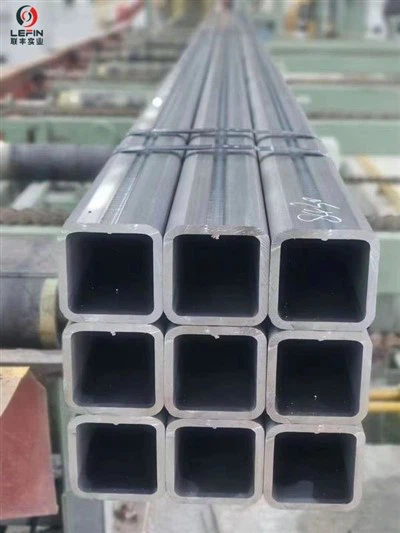
Oil Painting
Oil coating of steel pipe is an important process, mainly used to protect the surface of steel pipe, prevent corrosion and scratches.
Craft
- Oiling method: The oiling of steel pipes can be carried out in a variety of ways, including automatic oiling machines and manual oiling. Automatic oiling machine usually adopts PLC control system, which can realize the automation and uniformity of oiling.
- Oiling system: Some advanced oiling systems include oiling actuators, tubing components, etc., which can achieve quantitative oiling and improve the qualification rate and automation of oiling.
Material
- Oiling materials: Commonly used oiling materials include anti-corrosion paints, such as 6# and 10# paints, which can effectively protect the steel pipe from corrosion.
Application
- Industrial applications: steel pipe oil is widely used in pipeline transportation in oil, gas and other industries to extend the service life of steel pipes and meet export requirements.
- Other applications: In construction, machinery manufacturing and other fields, oil is also used to protect steel pipes from damage during transportation and construction.
Professional information source
- Patented technology: Many patents relate to equipment and methods for oiling steel pipes, such as quantitative oiling systems on the surface of steel pipe threads and their control methods, as well as oiling devices in steel pipes.
- Industry research: Relevant industry research reports provide a detailed analysis of the steel pipe lubricator market, including the industry life cycle, market supply and demand situation, etc.
After oiled steel pipe, how to check the quality of the coating?
Appearance Check
- Visual inspection: Observe whether the coating surface is smooth, uniform color, no wrinkles, bubbles, flow, pinholes, cracks, missed coating and other defects.
01
Coating Thickness Detection
- Thickness gauge measurement: Use a magnetic thickness gauge or eddy current thickness gauge to measure the thickness of the coating. The magnetic thickness gauge is suitable for measuring non-magnetic coatings on steel substrates, and the eddy current thickness gauge is suitable for measuring coatings on non-ferromagnetic metal substrates. The measurement should be carried out in different parts of the steel pipe to ensure the uniformity of the coating.
02
Adhesion Test
- Grid method: Draw a grid at a certain distance on the surface of the coating, then paste it with tape and tear it away quickly, and observe whether the coating falls off or peels.
- Drawing method: Paste a special drawing head on the coating, and then use a tension meter to pull, to measure the binding force between the coating and the substrate.
03
Pinhole Detection
- Electrical spark detection: Use an electrical spark detector to check the coating of the steel pipe to detect whether there is any electrical spark to determine whether there is a pinhole in the coating.
04
Chemical Resistance Test
- Immersion test: the steel pipe is placed in acid, alkali, salt and other chemical reagents for immersion test to simulate the corrosion effect of different chemical media on the steel pipe.
05
What is the difference between light and heavy oiling?
- Light oil: the amount of oil is low, usually in 0.5 ~ 1.0 g/m². This oiling method is suitable for short inventory cycle and high environmental protection requirements.
- Reoiling: the amount of oil is higher, usually 1.5 ~ 2.0 g/m². Suitable for poor transportation conditions, long storage and transportation or stamping lubrication requirements.
- Light oiling: It is often used in Japan and South Korea and other regions, because the steel mills in these regions are close to the main engine plant, and the main engine plant usually has the oiling cleaning process. In addition, domestic household appliance enterprises have low requirements for the amount of oiling.
- Reoiling: Suitable for the Americas, Europe and other regions, these regions often exist long-distance transportation and harsh environment, high requirements for the anti-rust ability of the coil.
- Light oil: Due to the small amount of oil, the rust prevention ability is relatively weak, but the cleaning and follow-up treatment is easier, suitable for occasions with high requirements for environmental protection and cleaner production.
- Reoiling: Strong anti-rust ability can better protect the surface of steel in long distance transportation and harsh environments, but cleaning and subsequent treatment may be more difficult.
The choice of different oil coating amounts mainly depends on the transportation conditions, storage environment and subsequent processing requirements of the product to ensure that environmental protection and production efficiency are taken into account while meeting the needs of rust prevention.