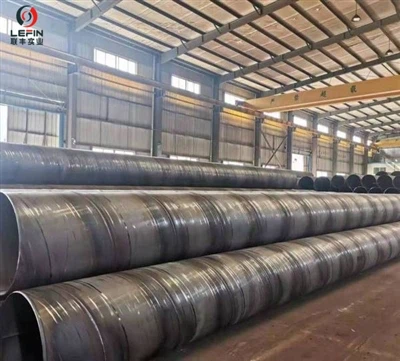
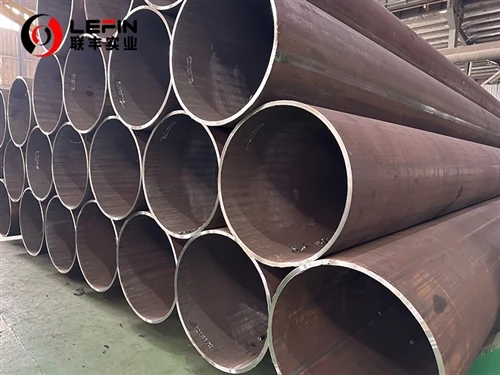
The EN 10217 standard
The EN 10217 standard encompasses a range of steel grades designed for various applications, particularly in the construction of pressure vessels and piping systems. These grades are meticulously formulated to meet specific performance criteria, ensuring reliability and durability in diverse industrial environments.
Chemical composition
The chemical composition of EN 10217 steel grades is carefully balanced to achieve desired mechanical properties and corrosion resistance.
| Chemical composition(cast analysis)a in%by mass | |||||||||||||||
| Steel grade | C max. |
Si max. |
Mn max. |
P Max. |
S max. |
Crb max. |
Mob max. |
Nib max. |
Al tot min. |
Cub max. |
Nbb max. |
Tib max. |
Vb max. |
Cr+Cu+Mo+Ni b max. |
|
| Steel name |
Steel number |
||||||||||||||
| P195TR1 | 1.0107 | 0.13 | 0.35 | 0.70 | 0.025 | 0.020 | 0.30 | 0.08 | 0.30 | - | 0.30 | 0.01 | 0.04 | 0.02 | 0.70 |
| P195TR2 | 1.0108 | 0.13 | 0.35 | 0.70 | 0.025 | 0.015 | 0.30 | 0.08 | 0.30 | 0.02d | 0.3c | 0.01 | 0.04 | 0.02 | 0.70 |
| P235TR1 | 1.0254 | 0.16 | 0.35 | 1.20 | 0.025 | 0.020 | 0.30 | 0.08 | 0.30 | - | 0.3c | 0.01 | 0.04 | 0.02 | 0.70 |
| P235TR2 | 1.0255 | 0.16 | 0.35 | 1.20 | 0.025 | 0.015 | 0.30 | 0.08 | 0.30 | 0.02d | 0.3c | 0.01 | 0.04 | 0.02 | 0.70 |
| P265TR1 | 1.0258 | 0.20 | 0.40 | 1.40 | 0.025 | 0.020 | 0.30 | 0.08 | 0.30 | - | 0.30 | 0.01 | 0.04 | 0.02 | 0.70 |
| P265TR2 | 1.0259 | 0.20 | 0.40 | 1.40 | 0.025 | 0.015 | 0.30 | 0.08 | 0.30 | 0.02d | 0.3c | 0.01 | 0.04 | 0.02 | 0.70 |
| a Elements not quoted in this table shall not be intentionally added to the steel without the agreement of the purchaser,except for elements which may be added for finishing the cast.All appropriate measures shallbe taken to prevent the addition of undesirable elements from scrap or other materials used in the steelmaking process,which would have a negative impact on the mechanical properties,ageing and the suitability of the material; b For qualities TR1 and TR2 supplied with non-specific inspection,the content of these elements need not be reported unless intentionally addedto the cast; c Option 3:In order to facilitate subsequent forming operations,an agreed maximum copper content lower than indicated and an agreed specified maximum tin content shall apply.In such cases a 3.1 Test Certificate shall be supplied for steel quality TR2(see Option 9); d For Al/N ratios≥2,if nitrogen is fixed by niobium,titanium or vanadium,details of which shall be reported,this requirement does not apply except that when using titanium,the steel producer shall verify that(Al+Ti/2)≥0.020%. |
|||||||||||||||
These elements contribute to the steel's strength, ductility, and weldability. Carbon increases strength but reduces ductility, while Manganese enhances strength and hardenability. Silicon can improve strength and hardness, and the low Phosphorus and Sulfur levels help prevent embrittlement and enhance weldability.
comparison of product parameters
| Table 1-Mechanical properties for quality TR1 | ||||||
| Steel grade | Tensile properties at room temperature | |||||
| Steel name |
Steel number |
Upper yield strength ReH min,for wall thickness T mm |
Tensile strength Rm |
Elongation A min.%a |
||
| T≤16 | 16 | |||||
| MPa | MPa | MPa | l | t | ||
| P195TR1 | 1.0107 | 195 | 185 | 320-440 | 27 | 25 |
| P235TR1 | 1.0254 | 235 | 225 | 360-500 | 25 | 23 |
| P265TR1 | 1.0258 | 265 | 255 | 410-570 | 21 | 19 |
| NOTE Tube grades in quality TR1 do not support the essential requirements of EU Directive 2014/68/EU in respect of pressure equipment. a l=longitudinal; t=transverse |
||||||
- Tensile Strength (Rm):
This is the maximum stress that the material can withstand before breaking. A high tensile strength ensures that the pipe can handle extreme loads without failure, making it suitable for high-pressure applications.
- Elongation (A min %):
Elongation is a measure of the ductility of the material, indicating how much it can stretch before breaking. Higher elongation values mean the material is more ductile and can absorb more energy before failure, which is beneficial in applications where flexibility is required.
| Table 2-Mechanical properties for quality TR2 | |||||||||
| Steel grade | Tensile properties at room temperature | Impact properties | |||||||
| Steel name |
Steel number |
Upper yield strength ReHa min. for specified wall thickness T mm |
Tensile strength Rm |
Elongationa A min. % |
Minimum average absorbed energya KV₂bJ at temperature of℃ |
||||
| T≤16 | 16 | l | t | l | t | ||||
| MPa | MPa | MPa | 0 | -10 | 0 | ||||
| P195TR2 | 1.0108 | 195 | 185 | 320-440 | 27 | 25 | 40 | 28c | 27 |
| P235TR2 | 1.0255 | 235 | 225 | 360-500 | 25 | 23 | 40 | 28c | 27 |
| P265TR2 | 1.0259 | 265 | 255 | 410-570 | 21 | 19 | 40 | 28c | 27 |
| NOTE Tube grades in quality TR2 are intended to support the essential requirements of EU Directive 2014/68/EU in respect of pressure equipment with specified room temperature properties.For use in pressure equipment in accordance with PED Categories II,III and IV,TR2 grades with specific inspection are necessary a I=longitudinal; t=transverse b KV₂=impact values obtained using a 2 mm radius striker in accordance with EN ISO 148-1 c option 5:In addition to the specijied impact test at 0℃,the longitudinal impact properties at-10℃ shall be verified and reported. |
|||||||||
- Impact Properties:
These properties, often measured using the Charpy impact test, indicate the material's ability to absorb energy and resist fracture under impact loads. This is particularly important in environments where the pipes may be subjected to sudden loads or temperature fluctuations.
The Difference Between EN 10217 TR1 and TR2
The mechanical properties of EN 10217 TR1 and TR2 steel grades are similar in terms of yield strength, tensile strength, and elongation. Both grades have the same minimum yield strength (ReH) and tensile strength (Rm) requirements, as well as similar elongation percentages. But they differ in their requirements for impact testing and additional inspection criteria.
- TR1: This grade does not have specified requirements for impact testing or specific inspection and testing requirements. It is generally used for applications where these additional properties are not critical.
- TR2: This grade includes specified requirements for impact testing, which means it must meet certain impact resistance standards. Additionally, TR2 has specific inspection and testing requirements that are more stringent than those for TR1. This makes TR2 suitable for applications where impact resistance and more rigorous quality control are necessary.
advantages
The advantages of EN 10217 steel pipes include:
High Pressure Resistance:
Capable of withstanding significant internal pressures, making them suitable for high-stress applications.
Corrosion Resistance:
Enhanced by protective coatings, which extend their service life in corrosive environments.


Uniform Material Characteristics:
The manufacturing process ensures consistent quality and uniform properties, reducing the risk of defects.
Weldability:
Good weldability allows for efficient construction and installation, especially in large-scale projects.
Applications
EN 10217 steel pipes are widely used in various industries due to their reliable performance:
Oil and Gas Industry:
They are used for long-distance transportation pipelines, offshore projects, and well drilling due to their high pressure resistance and corrosion resistance.
Construction:
Suitable for structural supports, piling, and building frames because of their strength and durability.
Chemical and Petrochemical Industries:
Ideal for use in processing equipment and piping systems due to their ability to handle corrosive materials.
Overall, the EN 10217 standard provides a robust framework for producing steel pipes that meet the demanding requirements of various industrial applications, ensuring reliability and performance in critical environments.