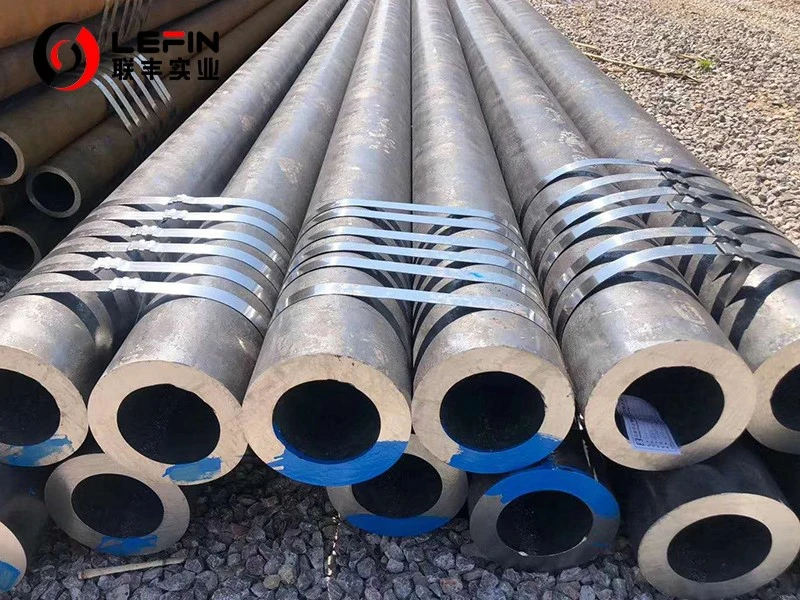
ASTM A53 Type S Grade B is the seamless variant of the most widely used general-purpose carbon steel pipe specification in the American system. It shares the same room-temperature strength as A106 Gr.B, but it is not designed for high-temperature process service. If your project calls for seamless construction and the operating temperature stays within moderate limits, A53 Type S Gr.B is usually the most cost-effective compliant choice.
What "Type S" Actually Means
ASTM A53 covers three manufacturing types under one specification: Type F (furnace-welded), Type E (electric-resistance welded), and Type S (seamless). The grade designation-Grade A or Grade B-is separate from the type.
This distinction matters at the purchase order stage. If you write "ASTM A53 Gr.B" without specifying Type S, the mill can legally supply ERW pipe. For buyers who require seamless construction, "Type S" must appear explicitly on the PO.
The practical consequence appears in pressure design. Under ASME B31.3, seamless pipe (Type S) carries a weld joint efficiency factor of E = 1.0. ERW pipe (Type E) carries E = 0.85, which forces a thicker wall for the same pressure rating. In pressure-critical applications, that wall thickness penalty often cancels out ERW's lower unit price.
Grade B Mechanical Properties
Type S is available in Grade A and Grade B. Grade B is the standard export grade.
| Property | Grade A | Grade B |
|---|---|---|
| Minimum yield strength | 205 MPa (30 ksi) | 240 MPa (35 ksi) |
| Minimum tensile strength | 330 MPa (48 ksi) | 415 MPa (60 ksi) |
Grade A is specified only when close coiling or cold bending is required-the standard explicitly notes Grade A is preferred for those forming operations, though it does not prohibit cold bending of Grade B. For general pressure and mechanical service, Grade B is the default.
Chemistry: What A53 Type S Leaves Out
This is the key comparison point against A106 Gr.B.
A53 Type S Gr.B has no minimum silicon requirement. It also allows higher phosphorus and sulfur than A106.
| Element (Grade B) | A53 Type S | A106 Gr.B |
|---|---|---|
| Silicon (min) | Not specified | 0.10% |
| Phosphorus (max) | 0.05% | 0.035% |
| Sulfur (max) | 0.045% | 0.035% |
No silicon minimum means the steel may be semi-killed rather than fully killed. For water, air, low-pressure steam, and general mechanical work, that is fine. For service near 400°C or under B31.3 process line classes, it is not.
Applications
A53's scope is broad: mechanical and pressure applications, plus ordinary steam, water, gas, and air lines. It can be welded, coiled, bent, and flanged.
Use it for:
Utility headers (water, compressed air)
Low-pressure steam
General mechanical and structural piping
Fire protection where seamless is mandated (galvanized Type E is more common)
Projects where the line class does not name A106
Do not use it for:
Refinery or petrochemical process piping under B31.3 line classes that specify A106
High-temperature steam above roughly 400°C
Boiler external piping that requires killed-steel chemistry
A53's service ceiling is often cited around 343°C (650°F) for general service, with Type S capable of somewhat more than ERW. A106 is accepted to 427°C (800°F).
Q&A
Q: Can I use A53 Type S Gr.B in place of A106 Gr.B if the mechanical properties match?
Mechanically, yes-at room temperature. But A106 requires silicon ≥0.10% and tighter P/S limits for high-temperature stability. If the line class specifies A106, substitution requires engineering approval and may affect code compliance.
Q: Why is A53 Type S sometimes cheaper than A106 if they come from the same mill?
The chemistry aim point is lower-no silicon addition required, wider P/S tolerance. For mills running both, the cost difference is often modest, but A53-only heats skip the killed-steel practice.
Q: Is A53 Type S available galvanized?
The A53 specification covers hot-dipped galvanized pipe, but galvanizing is typically applied to ERW (Type E) for cost reasons. Seamless galvanized is available but less common. A106 does not cover galvanizing.
For the full text of the requirements discussed here, refer to the ASTM A53 standard directly.
For detailed quotations, size and grade confirmation, or dual-certification questions, contact the Lefin Steel team with your project specification and line class.
Comparing with A106 Gr.B? See our separate article on that standard.