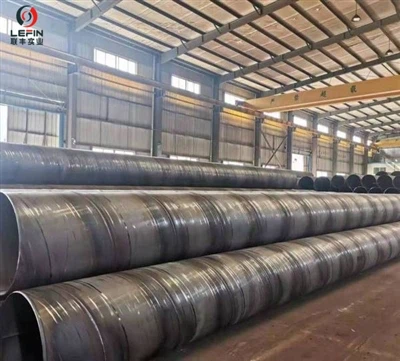
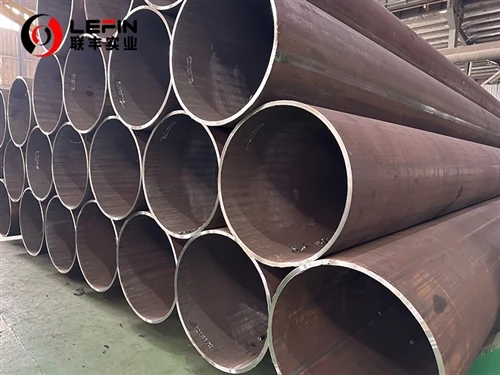
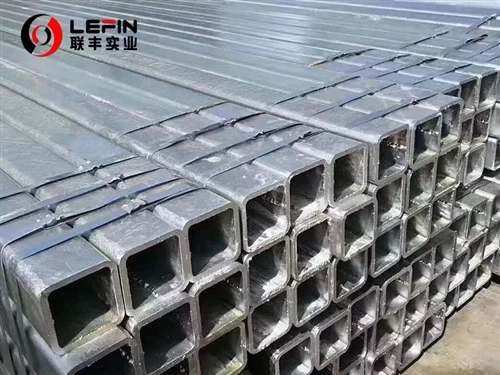
Overall, ASTM A500 and ASTM A501 are both important standards for carbon steel structural tubing, each designed to meet specific requirements and applications in the construction and manufacturing industries. While they share some similarities, such as being carbon steel products used for structural purposes, they have distinct differences that make them suitable for different applications.
CLICK HERE➡ to see more about ASTM A500
CLICK HERE➡ to see more about ASTM A501

Forming Process
ASTM A500:
The final forming process is cold-forming. Tubes are formed at room temperature. This process helps increase yield and tensile strength, making it suitable for applications where strength and dimensional accuracy are important.
ASTM A501:
The final forming process is hot-forming. Tubes are formed at elevated temperatures. This allows the structural tubing to better withstand impacts and deformations, making it ideal for applications requiring high elasticity and energy absorption capabilities.
Manufacturing Process
ASTM A500:
It can be manufactured using seamless or electric resistance welding (ERW) processes. The cold forming process results in tighter tolerances and a smoother surface, making it suitable for decorative and architectural uses.
ASTM A501:
It allows for a variety of manufacturing processes, including seamless, furnace butt welding (continuous welding), electric resistance welding (ERW), and submerged arc welding (SAW). The hot forming process gives the product higher yield and tensile strength, though it may have a rougher surface and looser tolerances.
Surface Finish:
ASTM A500:
Generally has a smoother surface finish due to the cold-forming process.
ASTM A501:
May have a rougher surface finish, especially if produced using a hot-forming process.

Chemical Composition
ASTM A500:
- This standard specifies carbon steel tubing with a more controlled chemical composition, including limits on carbon, manganese, phosphorus, sulfur, and other elements. The composition is tailored to ensure specific mechanical properties.
- Has a maximum carbon content of 0.26% for Grade B and D, and 0.23% for Grade C. It has higher manganese content (up to 1.40%) compared to ASTM A501.
ASTM A501:
- This standard allows for a broader range of chemical compositions, making it less restrictive than A500. It is typically used for structural purposes where the exact chemical composition is less critical.
- Has a maximum carbon content of 0.26% for Grade A and 0.22% for Grade B and C. It has stricter requirements for phosphorus (max 0.030% for Grade B and C) and sulfur (max 0.020% for Grade B and C), which provide better weldability.
Mechanical Properties
ASTM A500:
- The mechanical properties (such as tensile strength, yield strength, and elongation) are more tightly controlled. A500 tubing is available in multiple grades (e.g., Grade A, B, C, and D), each with specific mechanical property requirements.
- Has a maximum carbon content of 0.26% for Grade B and D, and 0.23% for Grade C. It has higher manganese content (up to 1.40%) compared to ASTM A501.
ASTM A501:
- The mechanical properties are generally lower than those of A500, and the standard does not have multiple grades. A501 is typically used in applications where high strength is not the primary concern.
- Has a maximum carbon content of 0.26% for Grade A and 0.22% for Grade B and C. It has stricter requirements for phosphorus (max 0.030% for Grade B and C) and sulfur (max 0.020% for Grade B and C), which provide better weldability.

Applications
ASTM A500:
Suitable for general building and bridge construction, especially where lighter construction and good stiffness are required. It is also used in decorative structures, fences, and agricultural equipment.
ASTM A501:
Commonly used for large bridges and building structures that need to carry large loads. It is preferred for applications requiring higher strength and toughness, such as heavy-duty support structures.
Summary
ASTM A500 is more stringent in terms of chemical composition and mechanical properties, making it suitable for higher-strength applications.
ASTM A501 is less restrictive and is typically used in general structural applications where high strength is not required.
In conclusion, the choice between ASTM A500 and ASTM A501 depends on the specific needs of the project. ASTM A500 is ideal for applications where dimensional accuracy and surface finish are critical, while ASTM A501 is better suited for projects that require higher strength and impact resistance. Understanding these differences allows engineers and designers to select the appropriate material for their structural needs.