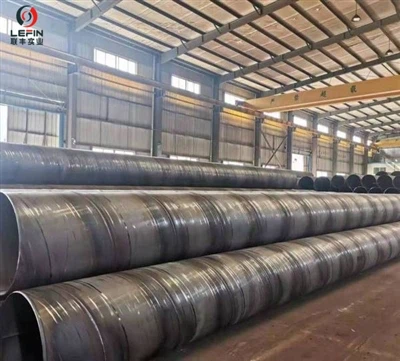
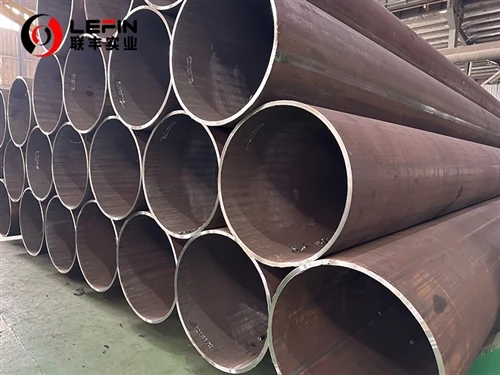
1. Comparison of manufacturing processes
| Process Features | LSAW (Straight Seam Submerged Arc Welding) | SSAW (Spiral Submerged Arc Welding) |
| Raw Materials | Single steel plate (width matching pipe diameter) | Steel coil (width independent of pipe diameter, diameter adjusted by spiral Angle) |
| Forming Method | Pre-bending of steel plate → Rolling into cylindrical shape → Straight seam welding (single longitudinal weld seam) | Continuous spiral rolling of steel strip → Spiral Angle forming → Spiral weld seam |
| Welding Method | Submerged Arc Welding (SAW), inner and outer double-sided welding | Submerged Arc welding (SAW), single-sided or double-sided welding (depending on requirements) |
| Typical Forming Processes | UOE (Press Forming), JCOE (Step-by-step Press Forming) | Continuous Helical forming, no complex molds required |
2. Performance and quality differences
| Indicators | LSAW | SSAW |
| Weld length | Short (only one straight seam) | Long (Spiral weld, length ≈1.2 times the pipe length) |
| Residual stress | Relatively small (symmetrical forming, uniform stress distribution) | Relatively large (Spiral forming causes uneven stress) |
| Pressure-bearing capacity | Higher (Straight seams are subjected to uniform force, suitable for high pressure) | Higher (Straight seams are subjected to uniform force, suitable for high pressure) |
| Dimensional accuracy | High (uniform wall thickness, good roundness) | Low (Spiral forming is prone to cause wall thickness fluctuations) |
| Defect control | Easy to detect (single straight seam, comprehensive NDT coverage) | Difficult to detect (long weld seam and spiral distribution) |

3. Application Scenarios
| Applicable Fields | LSAW | SSAW |
| Pipe diameter range | Usually ≥16 inches (406mm), up to over 60 inches | Typically 6 to 120 inches, with flexible adjustment of the spiral Angle to adapt to different diameters |
| Wall thickness range | Thick wall (can exceed 40mm) | Medium wall thickness (generally ≤25mm) |
| Typical Applications | High-pressure main lines, submarine pipelines, low-temperature environments, acidic media | Medium and low-pressure transportation, municipal engineering, pile foundation pipes, structural supports |
4. Summary of Advantages and disadvantages
| Type | Advantages | Disadvantages |
| LSAW |
✅ High pressure resistance, good dimensional accuracy ✅ Low residual stress, suitable for harsh environments ✅ Easy to detect weld defects |
❌ High cost (requires large equipment) ❌ Long production cycle ❌ The pipe diameter is limited by the width of the steel plate |
| SSAW |
✅ High material utilization rate (continuous production of steel coil) ✅ Flexible production (the same equipment can produce various diameters) ✅ Low cost |
❌ High residual stress, limited pressure-bearing capacity ❌ Long weld seam, high defect risk ❌ Not suitable for high-pressure/thick-walled scenarios |
5. Supplementary explanations
- Corrosion resistance:
- LSAW straight seam pipes, due to their uniform stress, are more suitable for scenarios that require strict anti-corrosion treatment (such as submarine pipelines +3PE coating).
- The SSAW spiral tubes are prone to stress concentration at the spiral welds and require additional anti-corrosion treatment.
- International standard requirements:
- In the API 5L standard, high-pressure conveying pipelines (such as PSL2 level) are more inclined to use LSAW pipes.
- SSAW pipes need to meet stricter weld seam inspection requirements in standards such as ISO 3183.

Summary
- Choose LSAW: high pressure, thick walls, harsh environments (such as deep sea, high cold, acidic oil and gas)
- Select SSAW: Medium and low pressure, economic projects, flexible diameter requirements (such as municipal engineering, temporary pipelines).
The actual selection should comprehensively consider cost, pressure level, environmental conditions and project cycle. If necessary, the two processes should be used in combination (such as LSAW for the main line and SSAW for the branch line).