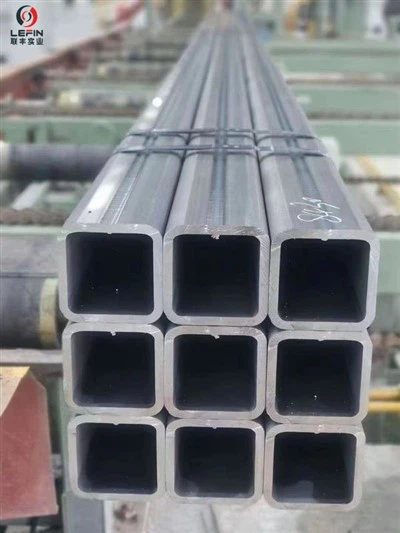
Overview of the Standards

Both standards define the requirements for carbon steel structural tubing produced by cold-forming and welding, but they originate from different regulatory and design philosophies.
ASTM A500 (Standard Specification for Cold-Formed Welded and Seamless Carbon Steel Structural Tubing in Rounds and Shapes) is the prevalent standard in North America and many other regions influenced by U.S. engineering practice. It covers round, square, rectangular, and special shapes for bridges, buildings, and general structural purposes. The standard is maintained by ASTM International.
EN 10219 (Cold formed welded structural hollow sections of non-alloy and fine grain steels) is the harmonized European standard. It consists of two main parts: Part 1 covers technical delivery conditions (steel grades, chemical composition, mechanical properties), while Part 2 meticulously defines tolerances, dimensions, and sectional properties for design calculations. Compliance with EN 10219 is essential for projects following the Eurocode design framework.
Key Comparison
The table below summarizes the critical distinctions between the two standards, which guide material selection.
| Feature | ASTM A500 | EN 10219 |
|---|---|---|
| Primary Scope | General structural purposes (buildings, bridges). | Structural applications within the Eurocode system. Includes specifications for demanding environments like offshore structures through related standards (e.g., EN 10225). |
| Steel Grades & Strength | Grades A, B, C, D based on minimum yield strength (ranging from 39 to 70 ksi). Grade D requires heat treatment. | Grades based on yield strength (e.g., S235, S355) and toughness (e.g., J2, K2, ML). Example: S355J2H is a common grade guaranteeing a minimum toughness. |
| Notch Toughness (Impact Resistance) | No mandatory requirements. The standard includes a cautionary note that products may not be suitable for dynamically loaded elements where low-temperature toughness is important. | Explicitly specified. Grades like S355J2H guarantee a minimum Charpy V-Notch (CVN) impact energy (e.g., 27 Joules at -20°C). |
| Dimensional Tolerances | Tolerances are defined, often as a simple percentage or absolute value. For example, wall thickness tolerance is generally ±10%. | Tolerances are highly detailed in EN 10219-2, varying with size and thickness. They are often stricter for certain parameters, especially for larger sections and thicker walls. |
| Sectional Properties | Generally calculated using nominal dimensions. | EN 10219-2 provides authoritative formulas in its annexes to calculate sectional properties (like moment of inertia) based on the defined tolerance limits, ensuring design reliability. |
| Product Range | Covers rounds and shapes with a perimeter ≤ 88 in. [2235 mm] and wall thickness ≤ 1.000 in. [25.4 mm]. | Covers a very wide range: circular sections up to 2500 mm OD, square up to 500x500 mm, rectangular up to 500x300 mm, with wall thickness up to 40 mm. |
Making the Right Choice: Application-Based Guidance
Choose ASTM A500 for:
Static Load Structures: Conventional building frames, warehouses, and support structures in non-seismic regions with static loads.
North American Projects: Where local building codes and engineering practice are based on AISC specifications that reference ASTM A500.
Cost-Sensitive Projects: Where the explicit toughness guarantees of EN 10219 are not a code requirement, potentially offering a more economical solution.
Choose EN 10219 for:
Dynamic or Cyclic Loading: Structures subject to fatigue, wind, seismic activity, or crane runways. The guaranteed toughness is a key safety factor.
Low-Temperature Environments: Offshore platforms (as covered in EN 10225-4), bridges in cold climates, or any structure where service temperature can drop significantly.
European and International Projects: Where design follows Eurocodes, making EN 10219 the compliant and streamlined choice.
High-Precision Fabrication: Projects where stricter dimensional tolerances are beneficial for complex joints or aesthetic exposed steelwork.
Frequently Asked Questions (Q&A)
Q1: Can I substitute an ASTM A500 Grade B tube with an EN 10219 S355J2H tube?
While their minimum yield strengths are similar (A500 Grade B: 46 ksi / ~317 MPa; S355J2H: 355 MPa), they are not automatically equivalent. The EN 10219 product has a verified notch toughness, which the ASTM product may lack. Substitution is possible only if the structural engineer confirms that dynamic impact resistance is not a design requirement for the specific component. The decision should never be based on yield strength alone.
Q2: Which standard offers better corrosion resistance?
Neither standard specifically addresses corrosion resistance through alloying. Both cover carbon steel. Corrosion protection (through galvanizing, painting, or using weathering steel) is a separate specification independent of the tube forming standard.
Q3: We are bidding on a project in the Middle East with a European consultant. Which standard should we quote?
You should absolutely quote products conforming to EN 10219, specifically with a relevant toughness grade (like S355J2H). European consultants will be designing according to Eurocodes, which are integrated with the EN 10219 standard for sectional properties and material specifications. Offering ASTM A500 could lead to compliance issues or require additional technical justification.
Q4: What about larger or thicker sections beyond the scope of these standards?
For applications requiring wall thicknesses greater than 40 mm or diameters above 2500 mm, other product forms are typically used. These include hot-finished hollow sections (EN 10210 / ASTM A1085), which have different mechanical properties and microstructures, or fabricated plate sections. Hot-finished sections are also generally recognized as having good inherent notch toughness.
Conclusion
The choice between ASTM A500 and EN 10219 is not merely a preference for an American or European standard; it is a technical decision with implications for structural integrity. ASTM A500 serves as a robust, performance-based standard for a wide array of general structures. In contrast, EN 10219 provides a more prescriptive and comprehensive framework, with built-in safeguards for toughness that make it the de facto choice for critical, dynamic, or severe-environment applications globally.
Our LEFIN STEEL as a manufacturer proficient in both standards, we are positioned to guide you through this selection process. By aligning your project's geographical, regulatory, and performance requirements with the appropriate standard, we ensure you receive a product that delivers not just on specification, but on safety and longevity.