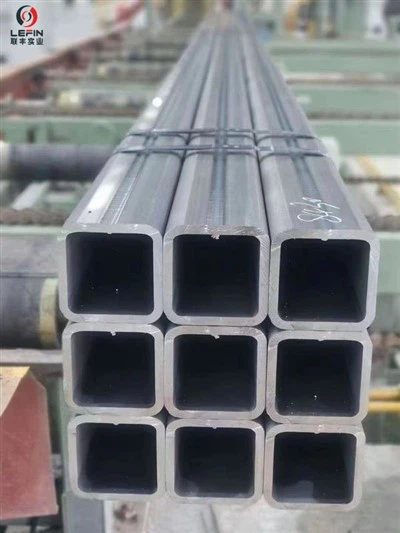
The correct storage of spiral steel pipes is of vital importance for ensuring their quality, extending their service life, and guaranteeing construction safety. The following are the main methods and precautions for storing spiral steel pipes:
I. Selection of Storage Location
1. Site requirements:
The site should be clean and well-drained, and should be far away from factories or mines that produce harmful gases or dust. All weeds and debris on the site must be removed, and the steel should be kept clean.
2. Ground treatment:
The ground should be solid and flat, preferably a hardened concrete surface. Avoid soft and water-permeable muddy ground to prevent subsidence that could cause the steel pipes to bend or tip over.
3. Storage method:
- Large steel sections, rails, and large-diameter steel pipes can be stored outdoors.
- Medium and small-sized steel sections, medium-sized steel pipes, etc. can be stored in a well-ventilated storage shed, but they must be covered on top and padded at the bottom.
- Small-sized steel materials, thin-walled steel pipes, and metal products with high prices and prone to corrosion should be stored in the warehouse.
II. Stacking and Piling Specifications
1. Lower floor elevation:
Steel pipes must not come into direct contact with the ground. The lower floor must be elevated using uniformly high sleepers, concrete strips, or special supports. The recommended elevation height is above 20-30 centimeters.
Specific elevation requirements:
• For warehouses with sunny cement floors: Elevate by 0.1 meters
• Mud: Raise the surface by 0.2 - 0.5 meters
• Open-air venue concrete floor: Raise 0.3 - 0.5 meters
• Open sandy and muddy ground: Raise the surface by 0.5 - 0.7 meters
2. Stack requirements:
• Stack height: For manual operation, it should not exceed 1.2 meters; for mechanical operation, it should not exceed 1.5 meters.
The width of the stack does not exceed 2.5 meters.
The stacking should be made stable. If necessary, it should be secured by ropes or special fixtures.
3. Channel Settings:
• The clearance width is generally 0.5 meters.
The entrance and exit passages vary depending on the size of the materials and the type of transportation machinery. They are typically 1.5 to 2.0 meters wide.

III. Protection and Maintenance Measures
1. Moisture-proof and rust-proof:
• For steel pipes that need to be stored for a long time, the pipe openings should be sealed with waterproof covers or plastic sheets.
• It can be regularly coated with anti-rust oil on the surface.
Open-air storage must be completely covered with a rainproof tarpaulin.
2. Anti-deformation Measures:
• For large-diameter or thin-walled spiral steel pipes, special attention should be paid to ensuring uniform support.
When stored outdoors, the stack surface should be slightly inclined to facilitate drainage.
For long-term storage, it is necessary to conduct regular inspections to check if the stack has any sinking or tilting.
3. Measures to prevent damage:
• During lifting and handling, special lifting tools should be used. Unauthorized rough handling is strictly prohibited.
The storage area should be kept away from operations that might cause mechanical damage to it.

IV. Safety and Classification Management
1. Classification storage:
Pipes of different specifications, materials, batch numbers and grades should be stored separately and identification signs should be hung at prominent positions.
2. Prohibition of mixed storage:
They must not be placed together with materials that are corrosive to steel, such as acids, alkalis, salts and cement.
3. Storage sequence:
Strictly follow the "first in, first out" principle and reasonably arrange the entry and exit of goods.
4. Regular inspection:
Conduct regular comprehensive inspections of the storage area, pallets and stack stability, especially before and after rainy seasons and strong wind weather.

V. Storage of Special Types of Steel Pipes
1. Open-air stacking requirements:
Angle steel and channel steel should be placed horizontally (with the opening facing downwards), I-beams should be placed vertically, and the I-shaped surface of the steel should not face upwards to prevent water accumulation and rusting.
2. Warehouse management:
In the warehouse, ventilation should be paid attention to on sunny days, and moisture-proof measures should be taken when it rains. The storage environment should be maintained in a suitable condition frequently.
By following these storage regulations, it is possible to effectively prevent the spiral steel pipes from getting damp, corroding, deforming or being damaged, thus ensuring that they maintain a good performance state during use.