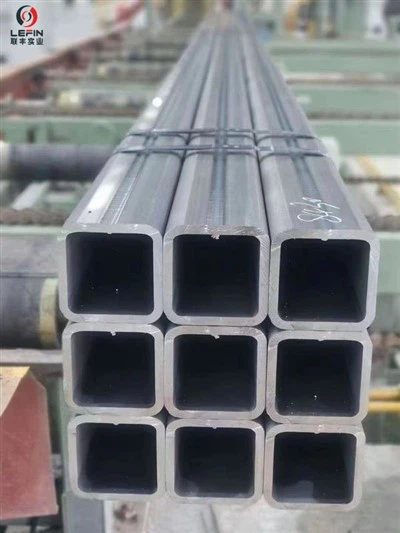
How are large-diameter square and rectangular tubes produced and formed?
What should be noted during the production process?
For large-diameter square and rectangular tubes (typically referring to those with a single side dimension of ≥ 200mm), the mainstream processes are either the round-to-square transformation (tube extrusion/rolling) or direct forming (steel strip rolling + high-frequency welding).
The core of production involves progressive forming, temperature and shape control, weld/film quality and residual stress control. For thick-walled/tall-sized tubes, round-to-square transformation is preferred; while for thin-walled/large-scale production, direct forming is adopted.
I. Main Production Processes and Molding Procedures
(1) Round-to-Rectangular Forming Method (Seamless / Thick-Walled Preferred)
Using seamless round pipes or welded round pipes as the raw material, through multiple passes of rolling dies or molds, from round → elliptical → elongated round → square / rectangular, the perimeter remains basically unchanged, and the metal plastic deformation completes the section conversion.
- Process Flow:
- Raw Material Preparation: Select qualified seamless round pipes (such as 20#, Q355B) or large-diameter welded pipes, conduct flaw detection, rust removal, and straightening.
- Heating (optional): Heat thick-walled pipes to 800–950℃ (improve plasticity, prevent cracking).
- Pre-forming: Progressive compression by multiple sets of rolling dies, the round pipe changes to elliptical, elongated circular, uniform wall thinning, and corner pre-pressing.
- Square Rectangular Forming: Special hole-type rolling dies or molds, gradually press the 4 corners to 90°, control the edge length, diagonal, and wall thickness uniformly.
- Diameter Control and Shaping: Fine rolling / straightening machine, correct size, straightness, distortion, control the round corner R (usually R ≤ 1.5 × wall thickness).
- Cooling: Air cooling or water cooling (control cooling speed, prevent stress cracking).
- Finishing and Flaw Detection: Cut to fixed lengths, flatten, polish; UT/MT flaw detection, measure size, wall thickness, hardness.
- Features:
No weld seam, high strength, uniform wall thickness, good corner quality; suitable for thick-walled pipes with dimensions 200×200–400×400mm and wall thickness 10–40mm; efficiency is lower than direct forming.
(2) Direct Forming Method (Steel Strip Rolling + High Frequency Welding, Thin Wall/Batch Production Preferred)
Hot rolled/cold rolled steel strips undergo winding, flattening, and multiple rolling processes to form U→O→square/rectangular shapes. They are then welded together using high-frequency induction welding, and the process is carried out continuously.
- Process Flow:
- Unwinding and Straightening: Unwind the steel strip, cut and weld it, and straighten it to eliminate waves/knives bends.
- Pre-bending Forming: Multiple forming rollers gradually bend the steel strip into U shape→O shape billets, with precise edge alignment.
- High Frequency Welding: Apply high-frequency current (200–450 kHz) to heat the edges to melting, and use extrusion rollers to weld them together. Remove any outer burrs (inner burrs may be removed as per requirements).
- Cooling: The welding section is cooled with water, reducing the temperature to below approximately 100°C.
- Square Rectangular Forming: The O-shaped billets enter the square/rectangular forming roller group, where the four corners are gradually bent to 90°, controlling the length, diagonal, and verticality.
- Diameter Control and Straightening: The fine rolling rollers control the diameter, and the straightening machine corrects the straightness and twist, controlling the flatness and verticality.
- Automatic Cutting to Length: Cut according to the length, with flat heads and deburring.
- Precision Inspection: Surface treatment, flaw detection, size/mechanical property testing.
- Features:
Continuous and efficient, low cost, good surface quality, high dimensional accuracy; suitable for thin-walled tubes with dimensions of 200×200–500×500mm and wall thicknesses of 3–12mm; has weld seams, and requires strict flaw detection.
(3) Other auxiliary processes (special specifications / small batch production)
- Hot extrusion:
The round tube billet is heated to 1100–1200℃, and then formed into a square/rectangular shape through a single extrusion in a die; suitable for extremely large diameters / thick walls / special materials (such as alloy steel, stainless steel), with high cost and small batch size.
- Cold drawing / cold rolling:
Seamless round tubes are gradually reduced in diameter and shaped into a square/rectangular shape through multiple cold drawing dies or cold rolling rolls; high precision, good surface, suitable for medium and small diameters with high precision tubes.
II. Key Precautions in the Production Process (Core Control Points)
1. Raw material quality control (preventing defects at the source)
- Material compliance: Q235B/Q355B/20# etc., with complete quality certificates, and the composition and mechanical properties meet the standards.
- Surface free from defects: no cracks, folds, scars, layers, rust pits; the steel strip has no sickle bends, wavy edges, or burrs.
- Dimensional stability: the ellipticity of the round tube billet is ≤ 1.5%, the thickness tolerance of the steel strip is ≤ ±0.1mm; the performance of the same batch of materials is uniform.
2. Process control during forming (preventing deformation, cracking, maintaining dimensions)
- Progressive forming: deformation per pass ≤ 10%, corners are slowly bent (R ≥ 1.2 × wall thickness), never pressurize to 90° at once (preventing micro cracks at corners and internal stress concentration).
- Temperature control:
- Heating for round-to-square transformation: 800–950℃, uniform heating (temperature difference ≤ 50℃), prevent local overheating and overburning.
- High-frequency welding: welding temperature 1350–1450℃, current/voltage matching, welding speed balanced with heat (preventing false welding, burn-through, excessive burrs).
- Cooling: segmented temperature control, water cooling after welding ≤ 100℃, mainly air cooling for thick-walled pipes (preventing sudden cooling and cracking).
- Dimension accuracy:
- Edge length tolerance: ±0.5–1.0mm (depending on the specification), diagonal difference ≤ 1.5mm, perpendicularity ≤ 0.5°.
- Wall thickness uniformity: deviation ≤ ±8%, corner wall thickness ≥ 90% of the side (preventing insufficient strength at corners).
- Straightness: ≤ 1.5mm/m, twist degree ≤ 1°/m (fine adjustment by straightening machine).
3. Weld Quality Control (Core of Direct Forming Method)
- Welding Parameters: Matching of high-frequency power, frequency, and welding speed, sufficient edge melting, proper extrusion, no false welding, slag inclusion, pores, or burn-through.
- Edge Finishing: Complete removal of external burrs (smooth transition), internal burrs ≤ 0.5mm (burrs on high-pressure/flow pipe need to be removed).
- Weld Inspection: 100% eddy current + ultrasonic inspection, in accordance with GB/T 11345 Level II or API 5L standards.
4. Surface Quality Control (Anti-scuffing, Anti-oxidation, Preservation of Appearance)
- Roller surface condition: The forming roller and guide rollers are smooth (Ra ≤ 1.6), without cracks, no steel adhesion, and are regularly polished to avoid hard scratches and indentations.
- Lubrication and cooling: The forming area uses emulsions/ specialized lubricants, for cooling, reducing friction, and preventing oxidation; the welding area is protected with protective gases (argon/nitrogen) to prevent weld oxidation.
- Surface cleaning: Remove oxide scale, welding slag, oil stains, and burrs; stainless steel pipes need to be acid-washed for passivation, and carbon steel pipes can be shot-blasted or sandblasted.
5. Residual Stress and Straightening Control (Preventing Later Deformation/Cracking)
- Stress Release: For thick-walled/high-strength steel (Q355 and above), post-forming stress relief annealing (holding at 550–650°C for 2–4 hours, air cooling) is performed to eliminate residual stresses from forming and welding, preventing later deformation, cracking, and stress corrosion.
- Straightening Process: Roller straightening is the main method, supplemented by pressure straightening; the spacing, angle, and pressure of the straightening rollers are precisely matched (too small causes surface damage, too large leaves residual stress); local deformation is precisely corrected using a press to avoid excessive straightening.
6. Inspection and Factory Control (Quality Closed Loop)
- Dimensional Inspection: Measure the edge length, wall thickness, diagonal, straightness, and distortion for each pipe. Use laser diameter gauge/vernier caliper/level.
- Non-destructive Testing: 100% UT/ET for welds, UT/MT for base material (for thick-walled pipes).
- Mechanical Properties: Take samples from each batch for tensile, bending, and impact tests, in accordance with GB/T 6728/GB/T 17200.
- Surface Inspection: Visual inspection + magnetic particle inspection (for critical applications). No cracks, scratches, rust, or deformation.
III. Common Defects and Prevention (Practical Focus)
- Corner cracking: Causes → Excessive deformation in one go, too small R value, low temperature, hard material; Prevention → Progressive forming, R ≥ 1.2 × wall thickness, thick wall heating, stress relief annealing.
- Welding defects (welding not fully fused or burn-through): Causes → Insufficient/high frequency power, too fast/slow welding speed, inaccurate edge alignment; Prevention → Parameter matching, precise alignment, stable welding speed.
- Dimension deviations (side length/angle diagonal/straightness): Causes → Wear/offset of forming rolls, improper straightening parameters, uneven cooling; Prevention → Regular calibration of roll sets, precise adjustment of straightening, uniform cooling.
- Surface scratches/indentations: Causes → Rough roll surface/steel adhesion, foreign objects entering, guide roller jamming; Prevention → Polish roll surface, clean production line, regular inspection of guide rollers.
- Residual stress deformation: Causes → Unannealed, too rapid cooling, excessive straightening; Prevention → Stress relief annealing, segmented temperature control, precise straightening.
IV. Summary
The core of large-diameter square and rectangular tube production lies in "gradual forming, temperature and shape control, reliable welds, clean surface, stress release, and precise inspection". The transition from round to square is suitable for thick-walled/ seamless high-demand scenarios, while direct forming is suitable for thin-walled/high-volume efficient production.
During the production process, strict control is required over the entire process including raw material, forming, welding, cooling, straightening, and flaw detection to avoid corner cracks, incomplete welding, size deviations, surface defects, and residual stress issues.