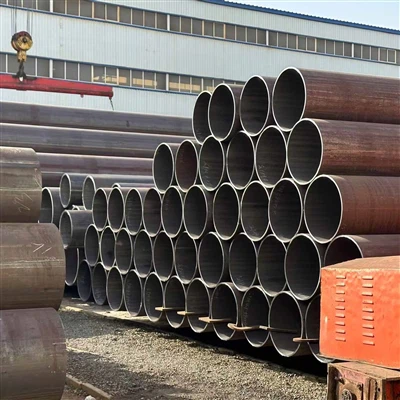
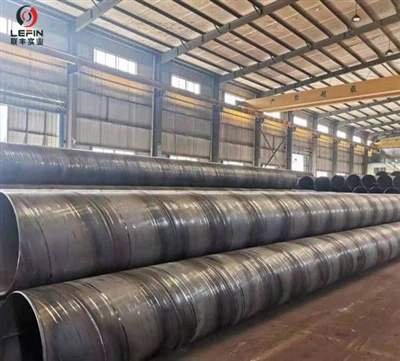
Storage Specifications for Straight Seam Welded Pipes (HFW/LSAW)
Core Principles: Elevate to prevent moisture, segregate by specification and steel grade, prevent rolling and crushing/bending, isolate from corrosive media, prioritize indoor storage; stricter requirements apply to thin-walled, galvanized, and anti-corrosion pipes.
I. Site Selection
1. Indoor warehouses are preferred: Ensure dryness, ventilation, and effective drainage. Keep away from acids, alkalis, salts, cement, dust, and corrosive gases. Strictly prohibit stacking with corrosive materials in the same bay. Ventilate on sunny days and close windows to control humidity on rainy days; maintain relative humidity below 60% whenever possible.
2. Open-air storage is only for temporary use (large-diameter, thick-walled bare pipes): The site must be level, with a compacted foundation and drainage slopes. Long-term open-air storage of thin-walled, galvanized, or externally coated straight seam pipes is not recommended. If stored outdoors, cover completely with waterproof tarpaulins, seal pipe ends, and prevent water accumulation inside the pipes to avoid rusting.
3. Keep away from heat sources, welding operation areas, and chemical storage zones.
II. Support and Base Layers (Crucial Priority)
• Must use wooden beams, railroad ties, steel supports, or concrete blocks; pipes must never be placed directly on the ground.
• Indoor elevation ≥150mm; outdoor elevation ≥200–300mm. Support spacing should be uniform (typically every 2.5–3m) to ensure even load distribution, preventing pipe bending and excessive deflection. Rubber pads may be added on top of supports to protect pipe ends and anti-corrosion layers.
• The top surface of support layers must be level. Outdoor stacks should have a slight tilt toward one side to facilitate drainage.
III. Stacking Methods and Height
1. Segregated Management: Separate by specification, steel grade, batch number, and wall thickness. Isolate qualified, pending-inspection, and rusted items. Use tag identification and implement First-In-First-Out (FIFO) principles.
2. Stacking Formats
• Round pipes should preferably be stacked in interlocking "flower" or "well" patterns. Wooden wedges/blocks must be added at the bottom layer to prevent rolling.
• Bundled finished pipes must remain intact. Place wooden separators between bundles to avoid scratching weld seams and outer surfaces.
• Anti-corrosion pipes (3PE/epoxy coated) require soft padding between each layer to prevent hard contact that could damage the coating.
3. Reference Stacking Heights (Safety + Prevention of Crushing/Deformation)
• Medium diameter (≤DN500): ≤4m; Large diameter (>DN500): ≤6m. Reduce height appropriately for thin-walled and galvanized pipes.
• Manual handling stacks: Height ≤1.2m; Mechanical forklift handling stacks: Height ≤1.5m. Maintain an operational aisle width of at least 1.5m between stacks.
4. Pipe End Protection: Pipe ends with bevels or threads must be fitted with plastic end caps to prevent impact damage and ingress of sand/water.
IV. Rust Prevention and Protection
• Bare pipes for long-term inventory (>3 months): Apply anti-rust oil or temporary anti-rust primer.
• Galvanized straight seam welded pipes: Focus on preventing condensation. Avoid tightly sealed multi-layer stacks; prioritize ventilation.
• Finished anti-corrosion straight seam pipes: Prohibit dragging and direct strapping with steel wire ropes. Use nylon lifting slings for hoisting to prevent coating damage. Repair damaged points promptly.
• Conduct focused inspections after rain or during plum rain seasons, checking for water accumulation and condensation at stack bases and pipe bottoms.
V. Inspection and Maintenance
• Regular Inspections: Check for rust, deformation, coating damage, label detachment, and stack instability.
• Localized Surface Rust: Remove rust and apply anti-rust treatment promptly. Severely rusted, crushed, or excessively bent pipes must be isolated separately.
• Long-term Storage (>12 months): Re-inspect appearance, dimensions, and weld quality before outbound delivery.
VI. Additional Considerations for Foreign Trade Inventory (Steel Pipe Export Scenarios)
• Separate by order batches to avoid material mixing.
• Short-term open-air storage awaiting shipment: Wrap securely with waterproof tarpaulins and seal pipe ends to prevent rusting prior to sea freight, which could lead to customer rejection.
• Galvanized/pre-painted straight seam pipes: Store indoors as much as possible. Salt spray corrosion occurs rapidly in coastal yard environments.