I. Breakdown of Causes by Process Stage (Production Perspective)
1. Raw Materials
- High S, P, and C content in strip steel → Increased tendency for hot shortness and cold brittleness;
- Laminations, inclusions, hard bends, and uneven local hardness in coils → Tearing along defects during forming;
- Scythe-like edge curvature, waviness, and excessive thickness tolerance deviations in strip edges → Uneven deformation during pipe rolling.
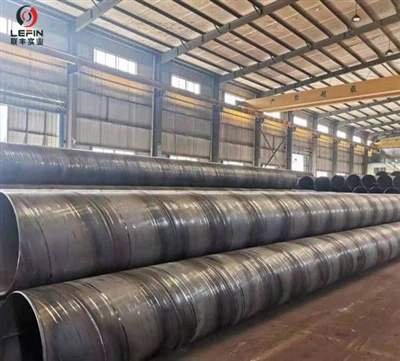
2. Forming Process (Specific to Spiral Welded Pipes)
- Insufficient downward pressure from the inner pressure roller → Inadequate deformation of the strip steel;
- Non-uniform distribution of deformation across the width → Overloading on one side due to tensile stress;
- Excessively high weld backing roller or incorrect roller profile; large misalignment in forming angle and alignment of inner/outer seams;
- Edge mismatch, excessive or insufficient gap → Stress concentration during welding.
3. Welding Process
- Hot Cracks: S/P segregation, excessively small weld formation coefficient (width-to-depth ratio), unfilled crater, improper positioning for uphill/downhill welding;
- Cold Cracks: Lack of preheating or insufficient preheat temperature, rapid cooling leading to martensitic hardening; moisture in consumables, rust/oil/water in bevels causing increased diffusible hydrogen; high-strength thick-walled steels are particularly sensitive;
- Welding heat input too high or too low, loss of control over interpass temperature.
4. Residual Stress and Subsequent Processes
- Unrelieved residual tensile stresses from welding and forming;
- External force impacts during sizing, straightening, cutting, and lifting;
- Embrittlement in low-temperature environments, leading to cracking under combined stress.
II. Prevention and Mitigation Measures (Directly Implementable)
Raw Material Control
- Select refined killed steel coils with low S, P, and C content; for high-strength steels, control carbon equivalent (CEV) and cold cracking susceptibility index according to standard requirements;
- Inspect incoming strips for scythe-like edge curvature, waviness, and thickness tolerance; perform ultrasonic testing to detect laminations and slag inclusions;
- Select welding wire and flux compatible with the steel grade; dry flux as specified and store it in a moisture-proof environment.
Forming Control
- Precisely adjust the angles and downward pressure of all forming rollers to ensure sufficient and uniform deformation across the width;
- Control the height and profile of the weld backing roller to avoid localized pressing;
- Strictly control edge mismatch, forming gap, and alignment of inner/outer seams to prevent deviation of the weld seam from the centerline;
- Directly reject sections of strip steel with hard bends or abnormal local hardness; do not coil them.
Welding Control
| Issue | Specific Measures |
| Prevent Hot Cracks | Control S and P content in base metal/welding consumables; ensure a reasonable weld formation coefficient (avoid narrow and deep profiles); fill craters at the end of welding; use start/stop tabs; avoid uphill welding which increases the tendency for weld tearing. |
| Prevent Cold Cracks | Preheat before welding based on steel grade and wall thickness; control interpass temperature; dry flux and clean bevels of rust, oil, and water; select low-hydrogen consumables; perform post-weld dehydrogenation treatment if necessary. |
| Control Heat Input | Match appropriate current, voltage, and welding speed to avoid overly rapid cooling or overheating; for thick-walled high-strength steels, prioritize preheating followed by slow cooling.

Stress Relief and Inspection
Stress Relief and Inspection
1. Perform post-weld heat treatment/stress relief when necessary to reduce residual tensile stress;
2. Conduct non-destructive testing (NDT) online and upon shipment: X-ray/ultrasonic inspection of welds, hydrostatic pressure testing;
3. Avoid impact and forced bending during cutting and lifting; prevent suspended loading during storage.