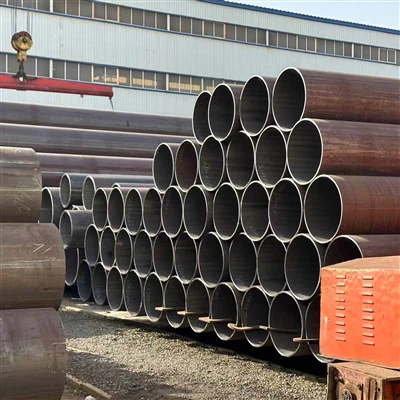
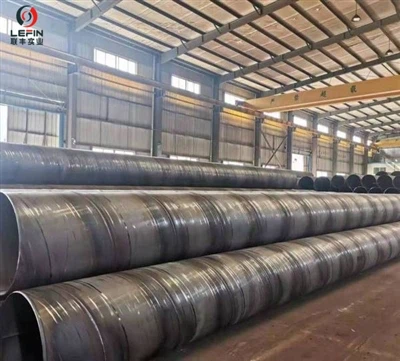
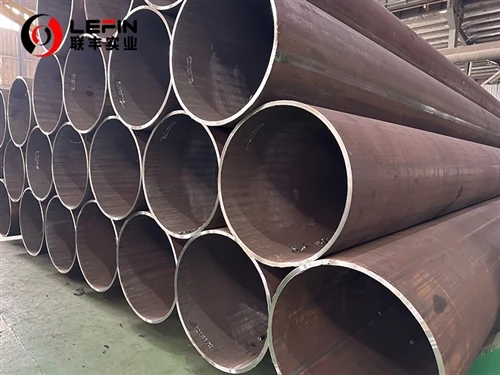
The core of the storage for spiral steel pipes revolves around four goals: rust prevention, deformation prevention, intact anti-corrosion coating, and classified management. It is necessary to follow the standard operating procedures based on the storage period, the type of steel pipe (bare pipe / anti-corrosion pipe / insulation pipe), and the site conditions. The specific requirements are as follows:
1. Basic requirements for storage site
1.1 Basic conditions
- Choose a site with higher terrain and smooth drainage. Set a 0.5% to 1% drainage slope on the ground and install drainage ditches to prevent water accumulation from soaking the bottom of the pipes.
- Clear the weeds, debris, and sharp objects on the site and keep the environment clean to prevent dust and corrosive media from adhering to the surface of the pipes.
1.2 Environmental isolation requirements
- Maintain a safety distance of ≥10 meters from corrosion sources such as chemical plants, electroplating workshops, and acid washing workshops. Also, keep away from strong vibration sources to prevent the pipes from deforming due to long-term vibration or coating detachment.
1.3 Storage method selection
- Short-term storage (within 1 month): Can be stored outdoors, with measures to prevent rain and moisture.
- Medium-term storage (1 to 6 months): Recommended to use semi-outdoor storage sheds, balancing ventilation and basic protection.
- Long-term storage, high-value anti-corrosion pipes, thin-walled pipes: Use fully enclosed warehouses to strictly control environmental humidity.
2. Core stacking norms
2.1 Elevating (key for rust prevention)
- Steel pipes must not be in direct contact with the ground. The bottom should be elevated using wooden blocks, concrete piers, or rubber pads:
- Outdoor site: Elevate ≥30cm, with block spacing ≤2m, evenly supporting to avoid local deformation.
- Indoor cement floor: Elevate 0.1m; mud floor requires elevation 0.2 to 0.5m.
- The stack surface should be slightly inclined to facilitate the rapid drainage of rainwater and prevent water accumulation on the pipes.
2.2 Stack height and stack width restrictions
- Manual handling operations: Stack height ≤1.2m; mechanical operations: Stack height ≤1.5m; stack width controlled within 2.5m.
- For large-diameter spiral steel pipes with a diameter ≥1 meter, the stack height is recommended not to exceed 2m to avoid elliptical deformation of the bottom pipes due to pressure.
2.3 Classification stacking principles
- Stack by specifications, materials, production batches, and anti-corrosion types, and clearly mark to prevent confusion and contact corrosion between different materials.
- For the same material, arrange in the order of entry into the warehouse, strictly following the first-in-first-out principle.
2.4 Safety and passage settings
- Reserve a 0.5m-wide inspection passage between stacks. The main transportation passage width is 1.5 to 2.0m to accommodate forklifts / traveling vehicles.
- Indoor stack positions should be at least 80cm away from the walls and at least 1m away from lighting facilities to avoid safety risks.
- Add wedge-shaped stop blocks or special supports at both ends of each stack to prevent the pipes from rolling and falling.

3. Operating points for different storage scenarios
3.1 Outdoor storage
- Use a rainproof cloth with a thickness of ≥0.5mm to cover completely. The coverage should extend at least 50cm beyond the edge of the stack. Use wind-resistant ropes to tie every 1.5m to prevent strong winds from lifting it.
- Before and after the rainy season, it is necessary to lift the rainproof cloth for special inspection. Dry the water on the pipes and check if the pipe ends are sealed to prevent water ingress.
- For 3PE anti-corrosion pipes with light-sensitive anti-corrosion layers, additional shading nets must be added to avoid long-term ultraviolet radiation causing coating aging and cracking.
3.2 Warehouse storage
- The warehouse should maintain good ventilation and the environmental humidity should be controlled below 60%. On sunny days, open windows for ventilation to reduce humidity, and close the doors and windows on rainy days to prevent moisture.
- Do not store with corrosive materials such as acids, alkalis, salts, and cement, to avoid contact with corrosion.
4. Special requirements for special types of steel pipes
4.1 Anti-corrosion coated steel pipes
- 3PE anti-corrosion pipes: Focus on UV protection, outdoor must add shading nets; avoid friction of the coating with hard objects during stacking, and cushion with flexible isolation materials between layers.
- Epoxy coal tar coating: Conduct monthly inspections once, focus on checking the integrity of the coating in the weld area; small areas of damage can be repaired with original factory-matched materials, and large areas of damage require returning to the factory for re-coating.
- Liquid epoxy coating: Conduct a quarterly inspection, avoiding scratches caused by sharp objects.
4.2 Large-diameter thick-walled spiral steel pipes
- Special plastic caps must be installed at the pipe openings to seal them, preventing debris and moisture from entering the pipes; for extremely large-diameter pipes, support rings need to be added inside the pipes to prevent elliptical deformation.
4.3 Insulation spiral steel pipes
- Avoid squeezing or bumping the insulation layer; store them properly to prevent water and moisture from entering and causing the insulation layer to fail; strictly prohibit stacking too high to avoid deformation of the insulation structure.

5. Daily management and maintenance
- For steel pipes with a storage period exceeding 6 months, re-inspect the corrosion condition, coating integrity, and roundness indicators before shipment.
- Conduct a comprehensive inspection of the stability of the stack, the corrosion and coating condition of the steel pipes every quarter; conduct annual maintenance of the drainage system, and replace the aging rainproof cloth and shading nets and other protective facilities every 2 years.
- Before extreme weather conditions (heavy rain, strong wind, hot and cold waves), reinforce the protective coverings, clear the drainage ditches, and take emergency protective measures.