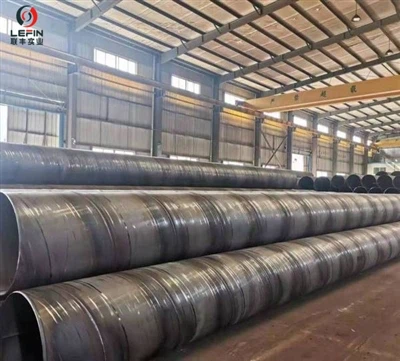
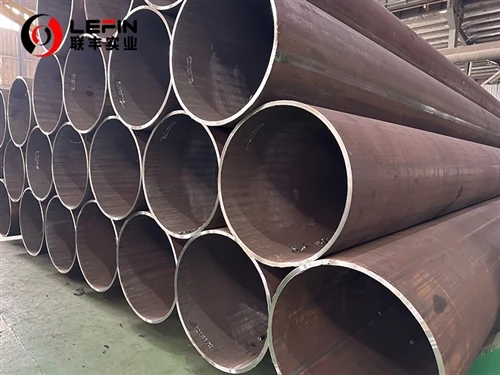
DSAW (Double Submerged Arc Welding) is double-sided submerged arc welding - the same weld seam is welded on both sides of the joint (for steel pipes, it's the inner side + the outer side). Submerged arc welding is the basic process (the arc burns beneath a granular flux layer), and "single-sided / double-sided" refers to the number of welding sides. In the pipeline industry, DSAW specifically refers to "inner weld + outer weld", and is mostly used for straight seam (LSAW, UOE/JCOE forming) and spiral seam (SSAW) large-diameter pipe sections. The industry also often mixes DSAW with LSAW.

Production processing differences
- Single-sided: Welding is done on one side without needing to turn the workpiece over, forming a weld through one pass with high efficiency and simple equipment; however, the back must be supported by a backing material (flux pad, copper pad, ceramic pad, etc.) to hold the molten pool, and it is sensitive to assembly quality and welding parameters, prone to burn-through or incomplete fusion
- Double-sided: The plate needs to be turned over (turning jig), and the steel pipe needs double-welding stations for the inner and outer sides. The process is more complex, and the equipment and cost are higher; but the first side only needs to ensure a certain weld penetration and no overflow (floating weld or flux pad), and the second side requires a large weld penetration coverage. The parameters fluctuation and assembly deviation are less sensitive
Quality differences:
Single-sided has a larger concentrated heat input, and the joint toughness is difficult to guarantee. The root penetration depends on the backing material and high current, there is a risk of incomplete fusion, slag inclusion, etc. at the root, and reliable full penetration often requires back cleaning and re-welding on the back; double-sided, the weld beads on both sides are superimposed, the root is completely fused, the full thickness weld penetration is reliable, the stress and deformation are more uniform, and it is suitable for pressure-bearing, dynamic load conditions (API 5L, ASME, etc. requirements)

Usage differences:
Single-sided is generally applicable to ≤14~20 mm thin medium plates, and in cases where the backside cannot be welded (closed structures, box-shaped beams, etc.); double-sided is used for 10~40 mm and above thick plates, pressure vessels, bridges, ships, and large-diameter oil and gas pipeline lines. In the early days of spiral pipe welding, single-sided submerged arc welding had problems with insufficient weld strength and incomplete fusion; nowadays, it is generally replaced by double-sided synchronous submerged arc welding
| Dimension | Single-sided submerged arc welding | Double-sided submerged arc welding (DSAW) |
|
Welding side |
Only one side of the joint | Weld both sides (steel pipe = inner welding + outer welding; flat plate = two sides) |
| Penetration method | Weld penetration method High current single-pass penetration with backing pad holding the molten pool | Both weld passes are superimposed, with the root fully melted |
| Applicable plate thickness | Generally ≤ 14~20 mm | Generally 10~40 mm and above |
| Process and equipment | No flipping required, simple equipment | Requires flipping jig or double-sided welding heads, more processes |
| Parameters / Assembly sensitivity | Sensitive, prone to burn through, incomplete fusion | Not Sensitive, stable quality, low defect rate |
| Heat input and toughness | The Heat input is concentrated and relatively large and toughness difficult to guarantee | Heat input dispersed, performance uniform and reliable |
| Efficiency and cost | One-time forming, high efficiency and low cost | An additional process leads to a higher cost |
| Typical applications | Thin plates, containers, occasions where double-sided welding is inconvenient | Thick plates, pressure vessels, large-diameter oil and gas pipelines (LSAW/SSAW pipes) |