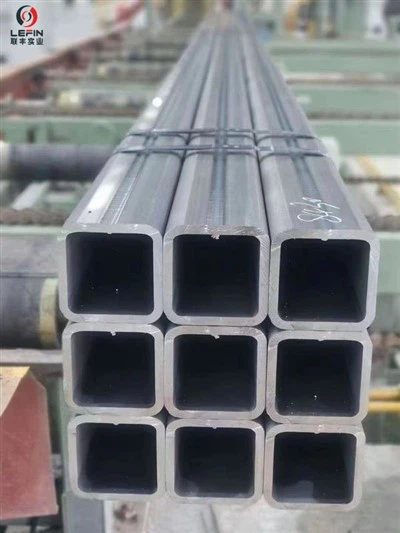
Chemical Requirements
| Composition,% | ||||
| Grade A | Grade B,C | |||
| Element | Heat analysis | Product analysis | Heat analysis | Product analysis |
| Carbon,maxB | 0.26 | 0.3 | 0.22 | 0.26 |
| Manganese,maxB | - | - | 1.4 | 1.45 |
| Phosphorus,max | 0.035 | 0.045 | 0.03 | 0.04 |
| Suffur,max | 0.035 | 0.045 | 0.02 | 0.03 |
| Copper,when copper steel is specified,min | 0.2 | 0.18 | 0.2 | 0.18 |
B For each reducton of 0.01 percentage point bebow the specfied maxinum for cabon,an increase of 0.06 percentage point above the specified maximum for manganese is pemmited,up to a maximum of 1.60% by heat analysis and 1.65%by product analysis.
- The higher carbon content in Grades B and C contributes to increased strength and durability, making them suitable for more demanding structural applications.
- Lower carbon content in Grade A enhances weldability, which is crucial for applications where joining of materials is required.
Mechanical Property
| Tensile | ||||
| Wall Thickness,in.[mm] | GradeA | Grade B | Grade C | |
| Tensile strength,min,psi [MPa] | AIl | 58000[400] | 65000 [448] | 70000[483] |
| ≤1 [25] | 39000 [270] | 46000[315] | 50000 [345] | |
| >1[25]and≤2[50] | 38000[260] | 45000[310] | 49000[340] | |
| Yield strength,min,psi[MPa] | >2[50]and≤3[76] | 36500[250] | 42500[290] | 47500[330] |
| >3[76]and≤4[100] | 35000[240] | 40000[280] | 46000[315] | |
| Elongation,min,% | 25 | 24 | 23 | |
- The higher yield and tensile strengths of Grades B and C provide greater structural integrity and load-bearing capabilities.
- Grade A offers a balance of strength and ductility.
Applications
Grade A: This grade is commonly used in general structural purposes where moderate strength is required. It is suitable for non-critical structural components that do not require high load-bearing capacities.
Grade B: Grade B is widely used in bridge construction, bolted structures, and riveted structures due to its high strength and good mechanical properties. It is ideal for manufacturing frames for large machinery and fuselage structures of aircraft, where high strength and toughness are necessary to withstand high pressure and harsh environmental conditions.
Grade C: Grade C is known to be used in applications that require even greater strength than Grade B. This grade is often specified for heavy-duty structural applications where the highest load-bearing capacity is essential.
Advantages
Grade A: Offers a balance of strength and ductility, making it versatile for a wide range of applications. It is also more cost-effective compared to higher grades due to its moderate strength requirements.
Grade B: Its high strength, good weldability, and corrosion resistance make it an indispensable material in bridge construction and other heavy-duty applications. The availability of various shapes and manufacturing processes ensures structural strength and quality.
Grade C: Presumably, Grade C offers the highest strength among the three grades, providing superior load-bearing capabilities for critical structural applications.
In summary, ASTM A501 grades A, B, and C differ in their applications, advantages, and significance. Grade A is versatile for general use, Grade B is essential for heavy-duty structures, and Grade C is critical for the most demanding applications. Each grade plays a unique role in the construction and engineering industry, ensuring the right material is used for the right application, thereby enhancing safety, efficiency, and structural integrity.