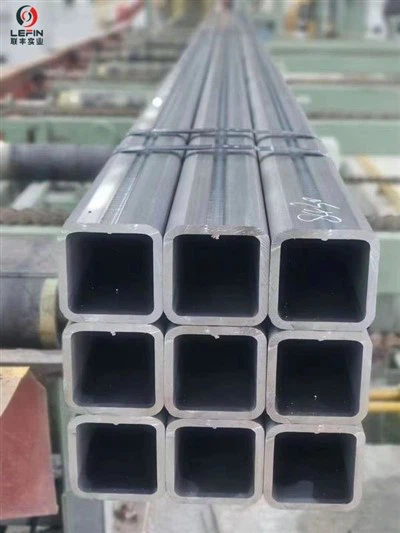
What are the differences between API5L PSL1 and API5L PSL2
API 5L (American Petroleum Institute Specification 5L) specifies requirements for the manufacture of two product specification levels (PSL): PSL1 and PSL2. LEFIN STEEL can do both API5L PSL1 and API5L PSL2 steel pipe. API5L pipe normally for transport gas, oil and water.
Differences:
1.Chemical element content:
PSL1:
PSL1 has a relatively simple chemical composition and is generally less restrictive than PSL2.
Carbon (C): Maximum of 0.28%
Manganese (Mn): Maximum of 1.20%
Phosphorus (P): Maximum of 0.030%
Sulfur (S): Maximum of 0.030%
Silicon (Si): Maximum of 0.45%
Niobium (Nb), Vanadium (V), Titanium (Ti), and other elements: Each maximum of 0.06%
Other residual elements: Each maximum of 0.05%
Total of all residual elements: Maximum of 0.15%
PSL2:
PSL2 has more stringent requirements for chemical composition, including lowering maximum limits for certain elements. It also requires more precise control of the levels of certain elements such as carbon, sulfur and phosphorus.
Carbon (C): Maximum: 0.24%
Manganese (Mn): Maximum: 1.40%
Phosphorus (P): Maximum: 0.025%
Sulfur (S): Maximum: 0.015%
Silicon (Si): Maximum: 0.45%
Niobium (Nb), Vanadium (V), Titanium (Ti): Maximum: 0.10%
Copper (Cu): Maximum: 0.50%
Nickel (Ni): Maximum: 0.50%
Chromium (Cr): Maximum: 0.50%
Molybdenum (Mo): Maximum: 0.15%
Other residual elements: Maximum for each: 0.10%
2.Mechanical properties
PSL1:
1. Yield strength (YS):
The minimum yield strength of API 5L PSL1 pipe varies by grade and size range. Typical values range from 210 MPa (30,500 psi) to 485 MPa (70,300 psi).
2. Tensile strength (TS):
The minimum tensile strength of API 5L PSL1 pipe varies by grade and size range. Typical values range from 310 MPa (45,000 psi) to 620 MPa (90,000 psi).
3. Elongation (%): Elongation measures the ability of a material to stretch or deform before breaking. It is expressed as a percentage and represents the amount of deformation (stretching) that occurs during a tensile test before the material breaks.
Minimum elongation values for API 5L PSL1 pipe are typically 21% to 30%, depending on grade and size.
4. Impact test (Charpy V-notch):
There is no mandatory requirement for impact testing for API 5L PSL1 pipes. Can be performed as supplementary testing according to customer or project specifications.
PSL2:
1. Yield strength (YS):
The minimum yield strength of API 5L PSL2 pipe varies depending on the grade and delivery condition (e.g. normalized, quenched or thermo-mechanically rolled). Typical values range from 245 MPa (35,500 psi) to 758 MPa (110,200 psi).
2. Tensile strength (TS):
The minimum tensile strength of API 5L PSL2 pipe varies depending on grade and delivery condition. Typical values range from 415 MPa (60,200 psi) to 965 MPa (140,000 psi).
3. Elongation (%):
Elongation is a measure of a material's ability to stretch or deform before breaking. It is expressed as a percentage and represents the amount of deformation (stretching) that occurs during a tensile test before the material breaks. Minimum elongation values for API 5L PSL2 pipe are typically 19% to 22%, depending on grade and size.
4. Charpy V-notch impact test:
API 5L PSL2 requires mandatory Charpy V-notch impact testing on all sizes and classes of pipe, including longitudinal, transverse and seam weld testing.

Non-destructive testing (NDT):
PSL1: NDT requirements are limited to pipe body probe testing (UT) and hydrostatic testing (usually the pressure is lower than PSL2).
PSL2: PSL2 requires additional non-destructive testing methods, such as electromagnetic inspection (eddy current or magnetic flux leakage), weld probe inspection, and more stringent hydrostatic testing.
Impact Test:
PSL1: Void Special agreement between manufacturer and requester, otherwise PSL1 is not mandatory for impact testing.
PSL2: PSL2 requires mandatory impact testing for all pipe sizes and grades. This helps ensure the pipeline's ability to resist brittle fracture under low temperature conditions.
Sour Service Performance:
PSL1: PSL1 pipe has not been specifically tested for resistance to hydrogen-induced cracking (HIC) and sulfide stress cracking (SSC) in sour service environments.
PSL2: PSL2 includes additional testing and more stringent requirements to ensure that pipe used in sour applications is resistant to HIC and SSC.
Contact: Nina 008618892236531(whatsapp), nina@lefinsteel.com(Email)
Advantages:
PSL1:
1. PSL1 pipe is generally less expensive than PSL2 due to lower testing and certification requirements.
2. Compared with PSL2, the requirements of PSL1 are simpler and more direct.
3.PSL1 has a long usage time and the requirements are not very strict.
4.PSL1 is suitable for applications where pipelines operate under relatively mild conditions, such as lower pressures and temperatures, or less corrosive environments.
5.PSL1 pipelines have proven their reliability and suitability for standard applications in the oil and gas industry.
6.PSL1 pipe generally has a simpler chemical composition and is easier to weld.
PSL2:
1.PSL2 pipes have stricter requirements on mechanical properties such as yield strength, tensile strength, elongation, etc.
2.PSL2 imposes tighter limits on chemical composition, including a lowered maximum carbon equivalent weight (CEIIW) value and additional limits on elements such as sulfur, phosphorus and other trace elements.
3.PSL2 requires notch toughness testing for all grades to ensure the pipe can withstand sudden impacts or stress concentrations without brittle fracture. Suitable for harsh environments
4.PSL2 requirements reduce the risk of sulfide stress cracking (SSC) and hydrogen-induced cracking (HIC)
5.PSL2 requires additional non-destructive testing (NDT) such as ultrasonic testing (UT), radiographic testing (RT) and magnetic particle inspection (MPI).
6.PSL2 pipes usually add alloying elements and specific manufacturing processes to enhance corrosion resistance and wear resistance.
7.PSL2 pipelines meet or exceed strict international standards and regulatory requirements and are suitable for use in critical infrastructure projects and areas with strict safety and environmental regulations.

Application:
PSL1:
1.API 5L PSL1 pipelines are widely used to transport natural gas and crude oil from production sites to processing plants, refineries and distribution centers. They are suitable for pipes operating at moderate pressures and temperatures.
2.PSL1 Pipeline Distribution pipelines used to transport natural gas and oil to residential, commercial and industrial consumers.
3.API 5L PSL1 pipes can also be used in industrial applications to transport water and various types of slurries.
4. In offshore oil and gas production, pipelines connect offshore platforms to onshore facilities or between various offshore facilities
5.PSL1 pipes are the first choice for pipes in mild ambient conditions where factors such as corrosion resistance and mechanical properties are less important.
6. In addition to the oil and gas industry, API 5L PSL1 pipes are also used in construction projects for structural applications and infrastructure development
PSL2:
1.PSL2 pipelines are commonly used in high-pressure transmission pipelines that transport oil, natural gas and other hydrocarbons over long distances.
2.PSL2 pipelines are suitable for pipelines installed in harsh environments, such as offshore oil and gas fields, exposed to corrosive seawater, strong winds and variable temperatures.
3.PSL2 pipe is designed for sour service applications where the fluid being transported contains hydrogen sulfide (H2S) gas.
4.PSL2 pipelines are suitable for critical infrastructure projects where reliability and long-term performance are critical
5. In applications where pipes are exposed to high operating temperatures, PSL2 pipes with enhanced mechanical properties and thermal stability are preferred to ensure structural integrity and safety.
6. PSL2 pipelines are used to cross mountainous areas, permafrost areas and earthquake zones. The pipelines must withstand ground movement and other geological stresses.