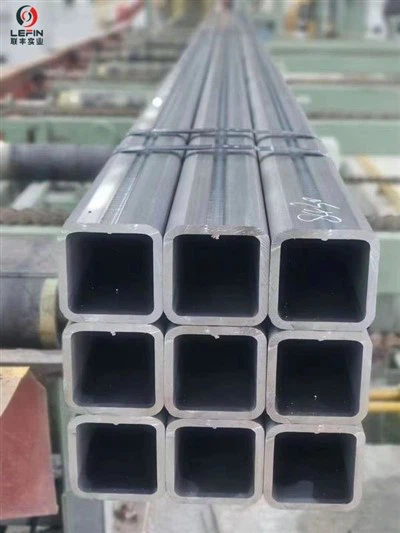
What are the differences between STKR400 and STKR490 materials in the JIS G3466 standard in specific application scenarios?
1. Mechanical properties and design load-bearing requirements
STKR400:
Tensile strength ≥400 MPa,
yield strength ≥245 MPa (refer to the yield strength of similar material STK490 ≥315 MPa).
Applicable scenarios:
Building structure: Medium-load structures such as ordinary factory steel beams, roof trusses, and shaft supports.
Photovoltaic support frame: Ground photovoltaic power station support frame (needs to be designed in accordance with JIS C8955 wind resistance).
Light machinery: agricultural greenhouse frames, furniture frames, small shelves, etc.
Advantages: Good weldability, easy cold bending and forming, and relatively low cost (about 4,500 to 4,930 yuan per ton).
STKR490:
Tensile strength ≥490 MPa,
yield strength ≥315 MPa (approximately 28% higher than STKR400).
Applicable scenarios:
Heavy-duty structures: main beams of Bridges, core tubes of high-rise buildings, and support frames for large industrial equipment.
Transportation: Container frames, railway vehicle chassis, heavy truck chassis components.
Energy facilities: Internal structure of wind power towers, pressure vessel supports, etc.
Advantages: High strength reduces the self-weight of the structure (such as in large-span designs), but the welding and cold bending processes have higher requirements. The price is 10% to 15% higher than that of STKR400.
2. Process adaptability comparison
| Features | STKR400 | STKR490 |
| Forming Process | The mainly adopts cold bending welding. When the wall thickness is ≤10mm, the tolerance is ±10%. | It requires precise cold bending or hot forming, with stricter wall thickness control (tolerance ±8%). |
| Weldability | The carbon content is relatively low (≤0.18%), and the risk of welding cracks is small. | High-strength steel needs to be preheated and undergo post-weld heat treatment to prevent embrittlement. |
| Corrosion-resistant | The surfaces are treated with oil coating or galvanization (refer to JIS G3302). | It is treated in the same way, but due to its high load capacity, it is mostly used in more demanding environments. |
3. Segmentation of typical application scenario
Common uses of STKR400
• Construction engineering: Support for residential floor slabs, framework for shopping mall canopies (such as 50×30×2.0mm small-sized pipes).
• Municipal facilities: guardrails, street lamp brackets, bus stop canopies.
• Mechanical manufacturing: Conveyor frames, small machine tool guards.
Typical applications of STKR490
• Heavy structure:
Bridge cantilever beams (such as 200×200×11.0mm large-sized pipes).
Port crane track support frame.
• Special fields:
Auxiliary supports for nuclear power equipment (requiring non-destructive testing).
Anti-roll frame for military vehicles (high impact resistance).
4. Selection suggestion
Scenarios where STKR400 is selected:
Medium and low-load projects with limited budgets.
• Scenarios that require rapid welding processing (such as on-site construction).
Structures with low sensitivity to weight (such as fixed shelves).
Scenarios where STKR490 is selected:
• High dynamic loads or impact environments (such as vehicle chassis, hoisting equipment).
• When weight reduction is required for large-span designs (such as the roofs of sports venues).
Heavy engineering projects that strictly meet seismic and wind resistance standards.

Summary: Core differences and applicability
| Compare Dimensions Strength Cost Process Difficulty | STKR400 | STKR490 |
| Strength | Medium (tensile strength ≥400MPa) | High strength (tensile strength ≥490MPa) |
| Cost | Low | relatively high (premium 10% to 15%) |
| Process difficulty | Low process difficulty (suitable for batch cold bending) | High process difficulty (requires temperature-controlled welding/heat treatment) |
| Typical scenarios | Photovoltaic brackets, light buildings Bridges | Heavy machinery, and energy facilities |
Note: The actual selection should be comprehensively evaluated in combination with the design load, environmental corrosiveness and processing conditions. For instance, galvanized STKR400 can be selected for photovoltaic brackets in humid coastal areas, while STKR490 should be given priority for the skeletons of cross-border logistics containers to cope with stacking impact.
What are the specific differences in welding processes between STKR400 and STKR490? Which parameters need special attention?
1. Differences in weldability and crack sensitivity
STKR400
• Low carbon equivalent (Ceq≈0.35) : Carbon content ≤0.18%, with less alloying elements, and a lower risk of cold cracking during welding.
• Wide adaptability to welding: Supports conventional welding methods (such as manual arc welding and gas shielded welding), with relatively small restrictions on heat input.
STKR490
• High carbon equivalent (Ceq≥0.42) : To meet the high strength requirements, more alloying elements (such as Mn, Nb, V) are added, and the hardening tendency of the heat-affected zone (HAZ) during welding is obvious, with high sensitivity to cold cracking.
• Strict preheating is required: It must be preheated to 80-150℃ (take the upper limit when the plate thickness is greater than 25mm) to reduce the risk of hydrogen-induced cracking.
2. Control of key process parameters
(1) Heat input (linear energy)
| Parameters | STKR400 | STKR490 |
| Allowable heat input | ≤40 kJ/cm (loose) | ≤25 kJ/cm (strict limit) |
| Reason | The toughness requirement is relatively low, and the influence of HAZ grain coarsening is smal | High-strength steel HAZ is prone to embrittlement, and the formation of the coarse-grained zone needs to be suppressed |
Note: When welding STKR490, multiple passes and narrow weld beads should be used to avoid the decrease in toughness caused by large line energy in a single pass.
(2) Interlayer temperature
• STKR400: ≤250℃ (conventional control).
• STKR490: ≤180℃ (strictly controlled), to prevent excessive high-temperature residence time from causing HAZ embrittlement.
(3) Post-weld heat treatment (PWHT)
• STKR400: Generally, PWHT is not required (unless it is for thick plates or in special environments).
• STKR490:
When the plate thickness is ≥25mm, tempering at 580-620℃ for 1 hour per 25mm is required to eliminate residual stress and restore toughness.
Avoid prolonged heating above 600℃ to prevent strength attenuation.
3. Welding method and material selection
• STKR400:
Recommended methods: Manual arc welding (E7015), CO₂ gas shielded welding (ER770s -6).
• Welding material: Match the strength of the base material (such as JIS Z3312 YGW18 welding wire).
• STKR490:
• Preferred method: Submerged arc welding (welding wire H08Mn2MoA + flux SJ101) or low-hydrogen electrode (E11018-G).
• Material requirements: The strength of the welding material should be "over-matched" (such as tensile strength ≥550MPa) to ensure that the joint strength is not lower than that of the base material.
4. Special attention
1. HAZ Resilience Assurance
When welding STKR490, it is necessary to monitor the HAZ impact energy (≥34J at -20℃). It is recommended to use TMCP process steel plates (fine-grained steel) to enhance toughness.
2. Large line energy welding limit:
STKR490 prohibits submerged arc welding (>50kJ/cm) or electroslag welding to prevent the formation of upper bainite in HAZ, which could lead to a sudden drop in toughness.
3. Enhanced Non-destructive Testing (NDT)
The weld seam of STKR490 requires 100% ultrasonic testing (UT) + magnetic particle testing (MT), with a focus on inspecting cracks in the weld toe and heat-affected zone.
4. Necessity of process Qualification:
Before welding STKR490, it must pass the welding procedure qualification (WPS/PQR), including tensile, impact and bending tests of the weld seam, and meet the standards of classification societies (such as DNV, ABS) or JIS Z3183.
5. Typical problems and countermeasures
| Problem | STKR400 Risk | STKR490 Risk | Response Measures |
| Cold crack | low | high | strict preheating + low-hydrogen welding material |
| HAZ embrittlement | medium | high | heat control input + multi-pass welding |
| Residual stress deformation | medium | high | post-weld heat treatment + rigid fixed tooling |
| Insufficient weld strength | low | medium | welding material over-matching + process qualification |
summary: comparison of core processes
| Project | STKR400 | STKR490 |
| Carbon equivalent | ≤0.35 (low crack risk) | ≥0.42 (high crack risk) |
| Preheating temperature | 80-120℃ (plate thickness ≤25mm) | 120-150℃ (plate thickness >25mm) |
| Heat input limit | ≤40 kJ/cm | ≤25 kJ/cm |
| Interlayer temperature | ≤250℃ | ≤180℃ |
| Post-weld heat treatment | usually not | necessary (tempering at 580-620℃) |
| Welding material | matching strength (E7015, ER770s -6) |
Over-matching (H08Mn2MoA, E11018-G) |
| NDT requirements | random inspection (20%) | 100% UT+M |
⚠️ Special note: The welding of STKR490 should follow the principle of "low heat input, strict preheating control, and strong inspection". In key structures such as ships and high-rise buildings, it is recommended to conduct process verification in collaboration with classification societies or certification bodies (such as ABS, DNV). If specific welding parameter templates are required, the JIS Z3312 or GB/T 985 standards can be referred to.