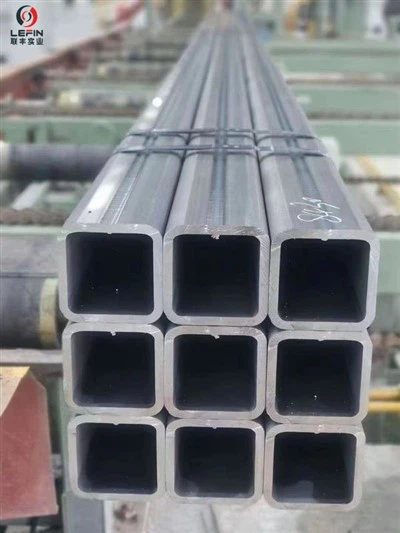
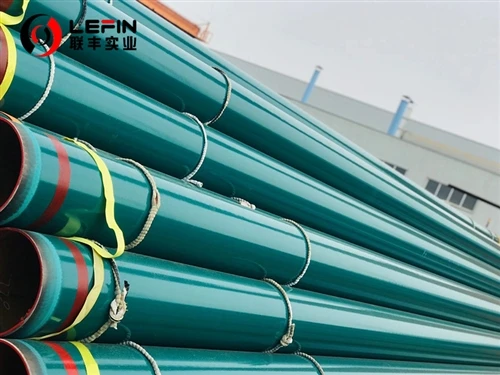
1. Definition and basic features
Longitudinally Submerged Arc Welding (LSAW) is a kind of steel pipe made by longitudinally submerged arc welding process, mainly used for transporting oil, natural gas and other fluids. Its features include:
- High strength and corrosion resistance: with double-sided submerged arc welding and expanding process, the weld is dense and can withstand high pressure and complex environment.
- Flexible specifications: wall thickness, diameter and length can be customized, especially for the production of large caliber thick wall pipes.
- Wide application: It is in great demand in oil and gas transmission, construction, machinery manufacturing and other fields, especially in harsh environments such as high pressure, high cold or seabed.
2. Production process
LSAW's production process consists of the following steps:
1. Raw material treatment: single medium thick plate as raw material, ultrasonic inspection to ensure no defects.
2. Molding: The steel plate is pressed into a tube blank by JCOE, UOE and other processes. Among them, the JCOE process adopts multiple step stamping to gradually form the "J-C-O" shape, which has strong adaptability and small residual stress, and is suitable for the production of thick wall pipes. The UOE process is more efficient but more expensive by forming and expanding twice.
3. Welding: longitudinal multi-wire submerged arc welding is used inside and outside to ensure weld quality.
4. Detection and treatment: through ultrasonic, X-ray and water pressure test to detect defects comprehensively, and eliminate internal stress after expanding.
5. Anti-corrosion and packaging: according to the demand for anti-corrosion coating, and finally cut and bind.
3. Application field
- Energy industry: the core material of oil and gas transmission pipelines, especially suitable for Class 1 and Class 2 areas such as high cold and submarine.
- Construction works: Used for natural gas pipelines, scaffolding structures, etc.
- Mechanical manufacturing: precision pipes for automotive chassis, exhaust pipes and other components.
- Other fields: Chemical, water and Marine engineering.
4. Market status and development trend
- Market size: Global sales reached $8.792 billion in 2022 and are expected to increase to $9.516 billion in 2029, with a CAGR of 1.51%. The Chinese market accounts for about 20% and is expected to reach 21.33% in 2029.
- Competitive landscape: Major enterprises include Welspun, Jindal SAW, petrochina Baoji Steel Pipe, etc., and the industry is highly concentrated.
- Technology trend: towards high performance materials (such as high alloy steel), intelligent production and green environmental protection.
5. Inspection and quality control
The weld quality of LSAW directly affects its safety, so multiple detection methods are used:
- Ultrasonic detection: cover weld and heat affected zone, can identify cracks, non-fusion and other defects.
- X-ray inspection: real-time monitoring of the internal structure of the weld through industrial television.
- Hydraulic test: check the bearing capacity one by one to ensure compliance with international standards such as API and DNV.
6.Summary
Due to its high strength, high precision and corrosion resistance, LSAW is the pipe of choice in fields such as oil and gas transportation. With the growth of global energy demand and technological upgrading, the LSAW industry will continue to develop in the direction of high performance, intelligence and environmental protection, and the competitiveness of Chinese enterprises in the global market will also be further enhanced.
7.advantages
The advantages of LSAW (straight seam submerged arc welded pipe) are mainly reflected in the following aspects:
1. High strength and high weld quality
LSAW uses a double-sided submerged arc welding process with high weld density, excellent ductility, homogeneity and toughness, and can withstand high pressure (such as X80/X100 steel grade) and complex environments. Its welds are tested by 100% ultrasonic, X-ray and water pressure tests to ensure that there are no cracks, non-fusion and other defects.
2. Large diameter and thick wall pipe production capacity
Using single sheet steel as raw material, thick-walled pipes with a maximum diameter of 422mm and a wall thickness of more than 50mm can be produced without the common crescent bend problem of spiral welded pipes, which is suitable for scenarios with high pipe strength requirements such as oil and gas transmission.
3. Process stability and dimensional accuracy
Through the JCOE or UOE forming process, the steel plate is formed into a uniform tube blank after several steps of stamping, and the residual stress is eliminated with the mechanical expanding process, which significantly improves the dimensional accuracy and compressive resistance. In addition, the weld of LSAW is parallel to the axis of the pipe body, and the direction of the principal stress is perpendicular to the weld, and the compressive performance is better than that of the spiral welded pipe.
4. Wide range of applications
It is suitable for oil and gas transmission (especially harsh environment such as high cold and seabed), construction engineering (such as natural gas pipeline), machinery manufacturing (automobile chassis, exhaust pipe) and Marine engineering. In the API standard, LSAW is the only specified pipe type for oil and gas transportation in Class 1 and Class 2 areas.
5. Intelligent and environmentally friendly production
Modern LSAW production lines integrate automated inspection systems (such as Olympus ultrasonic phased array probes) to reduce manual intervention and improve efficiency; At the same time, the performance is optimized by expanding diameter and hydrostatic test, which is in line with the trend of green manufacturing.
In summary, LSAW, with its high strength, high precision and corrosion resistance, has become the first choice for high-pressure, large-caliber pipes, especially in the field of energy and infrastructure.