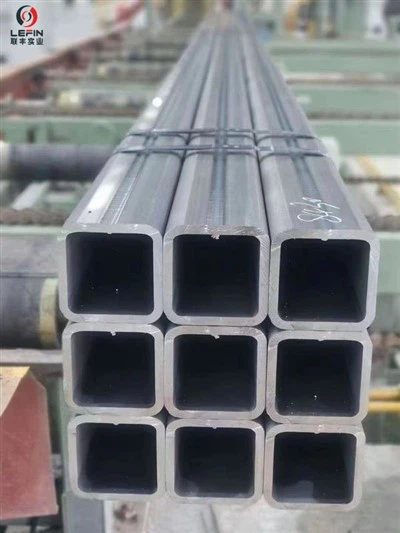
Scaffolding steel pipes are the core materials used in construction for setting up scaffolding structures. They are usually steel pipes with circular or square cross-sections and are assembled into a temporary support structure system that bears construction loads and provides working platforms through fasteners and other connecting parts.
The following table can help you quickly understand the main specifications, features and key requirements of scaffolding steel pipes:
| PROJECT | CONCRETE CONTENT |
| Common names | Shelf Tubes, Scaffold Tubes, 48-tube Tubes, Inch And A Half Tubes |
| Main material | Q235 common steel pipe (which should comply with the provisions of "Carbon Structural Steel" GB/T700) |
| Standard outer diameter | 48.3mm (allowable deviation ±0.5%) |
| Standard wall thickness | 3.6mm (with an allowable deviation of ±10%), and common specifications also include 2.75mm, 3.0mm, 3.25mm, 3.5mm, etc |
| Standard length | Usually 6 meters |
| Main features | High strength and rigidity, relatively light weight, anti-corrosion and fireproof, reusable, and flexible assembly |
| Key requirements | Strictly prohibit the use of steel pipes that are severely rusted, bent, flattened, cracked or perforated |

🔧 Safe use and storage maintenance
To ensure the safety of scaffolding projects, standardized operation and proper storage and maintenance are of vital importance.
• Erection and usage regulations:
Before setting up scaffolding, a special construction plan must be prepared. For major hazardous projects exceeding a certain scale, expert argumentation also needs to be organized. Erection workers (scaffolders) must hold special operation certificates to be on duty. During use, it is strictly prohibited to stack materials beyond the load limit. Regular checks should be conducted on the overall verticality, whether each connection point is loose or skewed, and whether the padded scaffold boards are firm, etc. After encountering winds of force 6 or above, heavy rain or heavy snow, re-inspection and acceptance are also required before resuming work.
• Key points for storage and maintenance:
When storing steel pipes for a long time, the most important thing is to prevent rust.
◦ Cover for rain protection: Opaque covers should be used for protection to prevent rusting of the steel pipes. At the same time, it is necessary to ensure that the covers are strong and durable and that the surface of the steel pipes is well-ventilated to avoid the difficulty of water vapor evaporation.
When storing, there should be supports to keep the steel pipes at a certain distance from the ground, ensuring good ventilation and dryness.
◦ Control the number of layers: The number of stacking layers should not be too many to avoid local deformation at the pipe ends due to force.
◦ Regular inspection: Regular maintenance and care such as rust prevention and rust removal should be carried out on components and parts. Components and parts with severe rust, deformation, cracks or other non-compliant conditions must be scrapped and are strictly prohibited from being used any longer.

💎 Main types and developments
In addition to the most common coupler-type steel pipe scaffolding, there are also bowl buckle type steel pipe scaffolding and socket-type disk buckle type steel pipe scaffolding, etc., depending on the different connection methods. The buckle-type scaffolding is being promoted and used in an increasing number of projects due to its higher safety performance and more convenient installation.