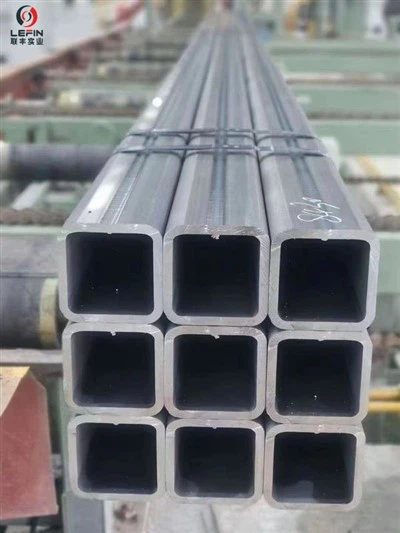
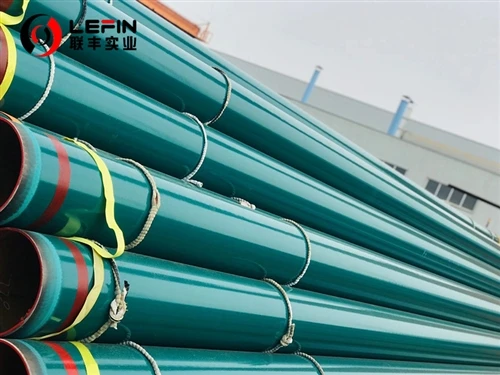
Overview of ERW welded pipe production process:
1. Raw material preparation: hot-rolled coil is selected as raw material and pre-treated with uncoiling, straightening, cutting end and tail, end butt welding and cutting edge.
2. Forming: The pre-treated steel strip is formed into a tube by the forming machine.
3. Welding: Using the skin effect and proximity effect of high frequency current, the edge of the tube blank is heated and melted, and the pressure welding is carried out under the action of the extrusion roll.
4. Remove burrs: After the welding is complete, use the welding burr removal device to remove the internal and external welding burrs at the weld.
5. Sizing and straightening: sizing and straightening the welded steel pipe to ensure its dimensional accuracy and straightness.
6. Inspection and testing: inspection and testing of finished steel pipes to ensure that their quality meets relevant standards and requirements.
7. Coating and packaging: As needed, the steel pipe is coated to improve its corrosion resistance and service life, and packaged for transportation and storage.

The detailed process flow of ERW welded pipe is introduced
Raw materials preparation
1. Steel coil selection: The selection of hot-rolled coils that meet the standards as raw materials, the quality of steel coils directly affects the subsequent production process and the quality of the final product.
2. Uncoiling and leveling: the steel coil is uncoiling and levelled by the leveling machine to eliminate the bending and warping of the steel coil during rolling and transportation to ensure the flatness of the steel plate.
3. Cut the head and tail and butt welding: cut the head and tail part of the steel coil, remove the unqualified part, and then perform end butt welding on the steel plate, and connect multiple steel coils into a long steel plate.
4. Cutting edge: Cut the two edges of the steel plate through the cutting machine, so that the width of the steel plate meets the production requirements, and ensure the parallelism and smoothness of the steel plate edge.
Molding
1. Pre-bending edge: The pre-bending machine is used to prebend the two edges of the steel plate, so that the edge of the steel plate has a certain curvature, so that it is easier to form a tube in the subsequent molding process.
2. Forming: The pre-bent steel plate is formed by the forming machine. The forming machine is composed of a plurality of forming rollers. By adjusting the spacing and Angle of the forming rollers, the steel plate is gradually bent into a tube shape. During the molding process, it is necessary to ensure that the diameter, wall thickness and shape of the steel pipe meet the production requirements.
Welding
1. High-frequency welding: The shaped steel pipe is sent to the high-frequency welding machine for welding. The high frequency welding machine uses the skin effect and proximity effect of high frequency current to heat and melt the metal on the edge of the steel pipe, and performs pressure welding under the action of the extrusion roll. In the welding process, it is necessary to ensure that the welding current, voltage, frequency and other parameters are stable to ensure the quality of the weld.
2. Weld cooling and curing: After the welding is completed, the weld needs to go through a period of cooling and curing process to ensure the strength and stability of the weld.
Post processing
1. Remove burrs: After the welding is completed, some burrs and bulges may be generated in the weld. You need to use the welding thorn removal device to remove these burrs and bulges to ensure the surface quality of the steel pipe.
2. Sizing and straightening: sizing and straightening the welded steel pipe to adjust the diameter, wall thickness and straightness of the steel pipe and other parameters, so that it meets the production requirements.
3. Flaw detection and testing: The finished steel pipe is inspected and tested to check whether there are defects in the interior and surface of the steel pipe. The commonly used testing methods include ultrasonic testing, eddy current testing, magnetic particle testing and so on.
4. Cutting and marking: cut the long steel pipe to the required length according to the need, and mark the identification and batch number and other information on the surface of the steel pipe.
5. Coating and packaging: According to needs, the steel pipe is coated to improve its corrosion resistance and service life. Finally, the finished steel pipe is packaged for transportation and storage.
Quality control
In the entire production process, strict quality control of raw materials, semi-finished products and finished products is required. Through the use of advanced testing equipment and means to ensure the quality of products in line with relevant standards and requirements.