What is JCOE and UOE Forming Process
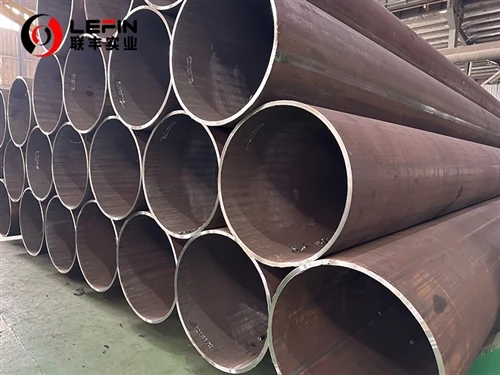
JCOE and UOE are two popular methods used for forming Longitudinal Submerged Arc Welded (LSAW) pipes. Both of these methods are widely used in the manufacturing of large-diameter pipes for oil and gas transmission, water transmission, and other industrial applications.
JCOE:
The JCOE (J-ing, C-ing, O-ing, and E-ing) process is a cold-forming process that involves the shaping of steel plates into a J- shape, followed by cold bending into a C-shape, and then expanding and forming into an O-shape. The final shape is achieved by a cold expansion process, which reduces the diameter of the pipe while simultaneously increasing the length. This method is highly efficient and results in a pipe with high dimensional accuracy and a smooth surface finish.
UOE:
The UOE (U-ing, O-ing, and E-ing) process is a hot-forming process that involves the shaping of steel plates into a U-shape, followed by an O-shape formation through the application of a continuous bending force. The final shape is achieved through an expansion process, which is carried out using a pressurized roller. This method is highly efficient and results in a pipe with excellent mechanical properties and a high degree of dimensional accuracy.
Both of these methods are highly effective for producing large diameter pipes that are suitable for use in a wide range of industrial applications. They are widely used in construction, oil and gas exploration, water and sewage treatment, and other industries where high-quality piping systems are required.


In conclusion, the JCOE and UOE LSAW pipe forming processes are highly efficient and reliable methods for producing high-quality pipes. By adopting these methods, manufacturers can ensure that their pipes meet the highest standards of quality and performance, providing their customers with reliable and cost-effective solutions for their piping needs.