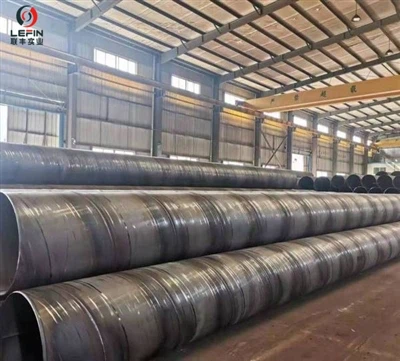
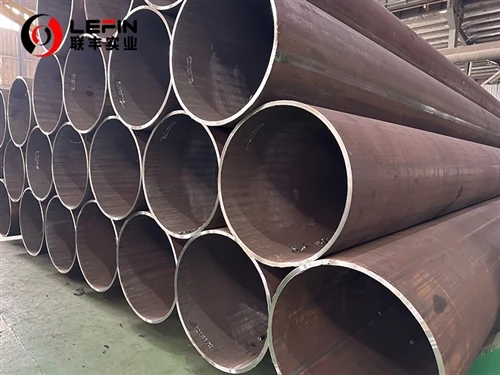
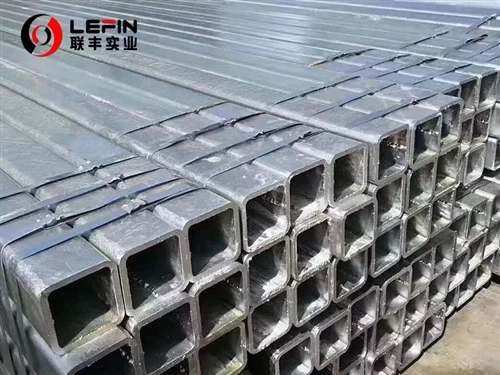
EN10210 is a European harmonized standard for thermoformed structural hollow profiles, including round, square and rectangular cross sections, which can be welded or seamless. This standard consists of two main parts: EN 10210-1 (technical requirements) and EN 10210-2 (dimensional specifications).
Standard introduction
- Main materials:Steel covered by EN10210 standard includes non-alloy and fine grain steel, steel strength grades including S235, S275, S355 and other different grades.
- Scope of application
The steel frame of the building structure
Industrial equipment manufacturing
Infrastructure projects (e.g. Bridges, towers)
Offshore engineering structure
Structural components that are subject to static or dynamic loads
- Manufacturing method: ERW (Resistance welding), SMLS (seamless),LSAW(Longitudinally Submerged Arc Welding)
- Shape: Rectangular, Square, Circle
- Steel grade: S235JRH, S275JOH, S275J2H, S355JOH, S355J2H, S355K2H
- Specification:
Rectangular pipe: size: 20*30-1500*1000mm wall thickness: 1.2-50mm
Square pipe: size: 200*200-1200*1200mm wall thickness: 1.3-50mm
Circle pipe: size: 1/2 - 24 inch wall thickness: 5-50mm
- Length: 6m / 12m, also depend on requirements
- Uses: mechanical pipeline, liquid conveying steel pipe, general structure, mechanical structure, conveying liquid, gas, oil, etc
- Forced testing: casting analysis, tensile testing, impact testing, surface condition and dimensions. Non-destructive testing (NDT) of welds for welded products
- Optional tests : product analysis, tensile test in corner area, impact test in corner area
- Pipe end: flat end/ chamfer end/ groove/ thread
- Coating: Black/ varnish/ 3PE/ galvanized/ fused epoxy coating
- Chemical and mechanical requirements
The EN10210 standard specifies in detail the chemical composition and mechanical properties of steel requirements, including the maximum content of carbon, silicon, manganese, phosphorus, sulfur, nitrogen and other elements of different steel grades, as well as tensile strength, elongation and impact test and other performance indicators.
Chemical Composition
| Unalloyed hollow section steel for steel structure | |||||||
| Analyze the melting chemical composition of products with thickness ≤65mm | |||||||
| GRADE | COMPOSITION % MAX | ||||||
| C | Si | Mn | P | S | N | ||
| Nominal thickness≤40mm | 40mm<Nominal thickness≤65mm | ||||||
| S235JRH | 0.17 | 0.20 | - | 1.40 | 0.045 | 0.045 | 0.009 |
| S275J0H | 0.20 | 0.22 | - | 1.50 | 0.040 | 0.040 | 0.009 |
| S275J2H | 0.20 | 0.22 | - | 1.50 | 0.035 | 0.035 | - |
| S355J0H | 0.22 | 0.22 | 0.55 | 1.60 | 0.040 | 0.040 | 0.009 |
| S355J2H | 0.22 | 0.22 | 0.55 | 1.60 | 0.035 | 0.035 | - |
Physical Property
| Mechanical properties of unalloyed steels | |||||
| GRADE | Yield strength | Tensile strength | |||
| Nominal thickness≤16 | 16<Nominal thickness≤40 | 40<Nominal thickness≤65 | Nominal thickness<3 | 3≤Nominal thickness≤65 | |
| S235JRH | 235 | 225 | 215 | 360-510 | 340-470 |
| S275J0H | 275 | 265 | 255 | 430-580 | 410-560 |
| S275J2H | |||||
| S355J0H | 355 | 345 | 335 | 510-680 | 490-630 |
| S355J2H | |||||
How is weld nondestructive testing carried out?
In the EN10210 standard, Non-Destructive Testing (NDT) of welds is an important link to ensure the quality of welded hollow profiles. The following are the specific methods and requirements for non-destructive testing of welds mentioned in the EN10210 standard:
General requirements:
When non-destructive testing is required for the welds of welded structural hollow profiles, it shall be carried out in accordance with Section 9.4 of EN10210-1:2006. Manufacturers can decide whether to test on a circle before final molding, or on a round, square, rectangular or oval hollow profile after final molding.
Electric weld:
The inspection of electric welds shall follow one of the following European standards:
EN 10246-3, accepts grade E4 but does not allow the use of rotating tube/disc coil technology;
EN 10246-5, accepted grade F5;
EN 10246-8, accepted grade U5
Submerged arc welding joint
Submerged arc welding joints shall be inspected in accordance with EN 10246-9, acceptance level U4, or radiographic inspection in accordance with EN 10246-10, image quality level R2.
Butt welds used to join strip/plate lengths are permitted in the submerged spiral arc welding process, provided that the butt welds are inspected by the same procedures as the main welds and meet the same acceptance rating.
Non-destructive testing methods
Commonly used nondestructive testing methods include ultrasonic testing (UT), X-ray testing (RT), magnetic particle testing (MT), liquid penetration testing (PT), etc.
Ultrasonic detection uses the propagation characteristics of high-frequency sound waves in the material to detect the defects inside the weld, which is suitable for welding seams with large thickness.
X-ray inspection uses X-rays or gamma rays to penetrate the weld and observe defects on the image produced after the rays penetrate the material
Weld surface quality
The surface quality of the weld can be observed with the naked eye or with a magnifying glass; Non-destructive testing of weld content defects requires non-destructive testing technology, commonly used ray method, ultrasonic method, magnetic powder method, penetration method and so on.
Through these methods, the internal and surface defects of the weld can be effectively detected to ensure the quality and safety of the welding structure. Nondestructive testing is an important part of welding quality control, and it is very important to ensure the reliability and safety of the structure.