ASTM A106 and ASTM A500 are two widely used steel pipe standards in the industrial field, but they have significant differences in design goals, material properties, manufacturing processes and application scenarios. The following is a specific comparison from the core dimension:
1. Core uses and design objectives
ASTM A106
- Application: Specifically designed for the transportation of high-temperature and high-pressure fluids, it is commonly found in steam pipelines, thermal pipelines and other systems in the petroleum, chemical and power plant industries.
- Design objective: Emphasize pressure resistance, heat resistance and sealing performance in high-temperature environments, and be able to withstand long-term high-temperature creep and pressure shock.
- Typical scenarios: oil refinery pipelines, boiler systems, high-temperature heat exchangers.
ASTM A500
- Application: It is suitable for static load-bearing scenarios such as building structures and mechanical supports, including bridge frames, building columns, and mechanical brackets.
- Design objective: Optimize structural strength, bending and compressive resistance performance, and dimensional accuracy, with a focus on load stability under cold forming processes
- Typical scenarios: steel structure buildings, bridge trusses, vehicle chassis.
2. Material properties and performance requirements
Comparison of mechanicalproperties:
| Parameter | ASTM A106 (Class B) | ASTM A500 (Class B) |
| Tensile strength | ≥60,000 PSI | 58,000-80,000 PSI |
| Yield strength | ≥35,000 PSI | ≥46,000 PSI |
| Elongation | ≥30% | ≥23% |
Note: The C/D grade of A500 has a higher strength (yield strength ≥50,000 PSI) and is suitable for heavy-duty structures.
Chemical composition differences
ASTM A106:
The carbon content is ≤0.30%, the manganese content is 0.29-1.06%, and the sulfur (≤0.035%) and phosphorus (≤0.035%) are restricted to reduce high-temperature brittleness.
ASTM A500:
The range of carbon and manganese content is wider (for example, Grade B: carbon ≤0.26%, manganese ≤1.35%), and the restrictions on sulfur and phosphorus are relatively lenient (sulfur ≤0.05%, phosphorus ≤0.04%).
3. Manufacturing process and form
ASTM A106:
• Process: Only seamless manufacturing (hot rolling or cold drawing), ensuring no weak points in the weld seam under high temperature and high pressure.
• Form: Only circular cross-section.
ASTM A500:
• Process: Supports welding or seamless welding, and requires cold forming processing to enhance strength.
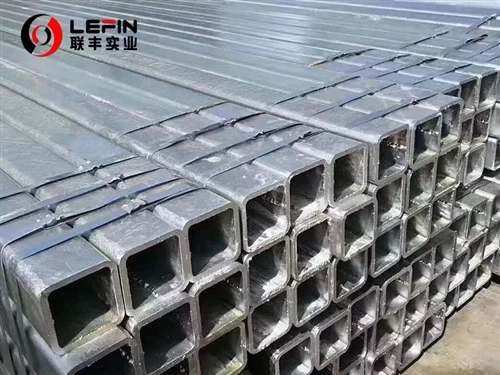
• Form: It covers various cross-sections such as circular, square, and rectangular, adapting to different structural requirements.
4. Applicable environment and special requirements
ASTM A106:
• Temperature resistance: It can withstand a long-term high temperature of ≥540°C and must pass a high-temperature tensile test.
• Testing requirements: Forced hydrostatic test and non-destructive testing (such as ultrasonic testing) to ensure no leakage.
ASTM A500:
• Environmental adaptability: Suitable for static structures at normal or low temperatures, with no high-temperature performance requirements.
• Inspection focus: Dimensional tolerance (outer diameter ±1%, wall thickness ±10%), surface flatness.

5. Standard system and grade classification
| Standard | Grade | Typical Application Scenarios |
| ASTM A106 | A, B, C | B grade is the most common (high-temperature pipes) |
| ASTM A500 | A, B, C, D | B (General Structure), C/D Grade (Heavy Support) |
summary: Core differences and selection suggestions
Essential difference:
ASTM A106 is a standard for fluid piping, focusing on high-temperature sealing and pressure resistance. ASTM A500 is a standard for structural tubes, emphasizing load-bearing strength and geometric accuracy.
Selection scenario:
• Select A106: High-temperature steam, oil and gas transportation, and power pipeline systems.
• Select A500: Static structures such as building frames, mechanical supports, and traffic facilities.
• Non-interchangeable: Due to the distinct design goals and performance requirements, the two cannot be substituted for each other.
For further comparison of specific parameters (such as size range and impact toughness), the original text of ASTM A106-19 and A500-23 standards or the engineering manual can be referred to.