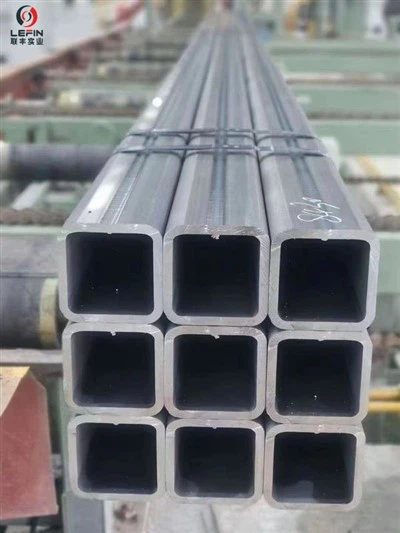
Understanding the differences between cold drawing (also known as cold extrusion) and hot rolling of steel pipes is crucial for making the right material selection. These two processes determine the accuracy, performance and application scenarios of the steel pipes. The following table clearly contrasts their core differences.

| Comparison dimension | Cold-drawn (cold-rolled) steel pipe | Hot-rolled steel pipe |
| Process principle | Drawing or rolling is carried out below the metal recrystallization temperature (usually at room temperature), | Rolling is carried out above the metal recrystallization temperature (usually over 1000℃) |
| Product appearance | The surface is shiny and smooth (Ra 0.4 - 0.8 μm). | There is oxide scale or red rust on the surface, making it rather rough (Ra 12.5 - 25 μm). |
| Dimension accuracy | High dimension accuracy, with small tolerance (up to ±0.05mm), and uniform wall thickness. | Dimension accuracy is relatively low, with larger tolerance (about ±0.2mm), and the uniformity of wall thickness is slightly worse. |
| Mechanical properties | High strength and hardness, but relatively low plasticity and toughness.There may be residual stress from work hardening. | Good plasticity and toughness, excellent comprehensive mechanical properties. Heat treatment can eliminate internal stress. |
| Production cost and efficiency | Long production cycle, many processing steps, high cost, suitable for small and medium batch customization. | High production efficiency, suitable for large-scale continuous production, low cost. |
| Typical applications | Hydraulic and pneumatic systems, precision instruments, automotive transmission shafts, medical devices and other high-precision fields; | Fluid transportation, building structures, low-pressure boilers, municipal engineering and other occasions with lower precision requirements. |

How to make a choice based on requirements?

Based on the above comparison, you can make your choice by following these principles:
• When aiming for high precision and good surface quality:
If your application scenario has strict requirements for the size accuracy, surface smoothness, and uniformity of wall thickness of the steel pipe, cold-drawn steel pipes should be the preferred choice. For example, hydraulic cylinder barrels, precision mechanical parts, etc.
• When considering comprehensive mechanical properties and cost:
If the application places greater emphasis on the overall strength, toughness and plasticity of the structure, and involves large structural components or fluid transmission pipelines, with less stringent requirements on surface and dimensions, hot-rolled steel pipes are a more cost-effective option.
• Consider budget and production volume:
For small batches and customized high-precision requirements, cold-drawn pipes are more suitable. For large volumes of standard pipes, hot-rolled pipes have significant advantages in terms of cost and production efficiency.