


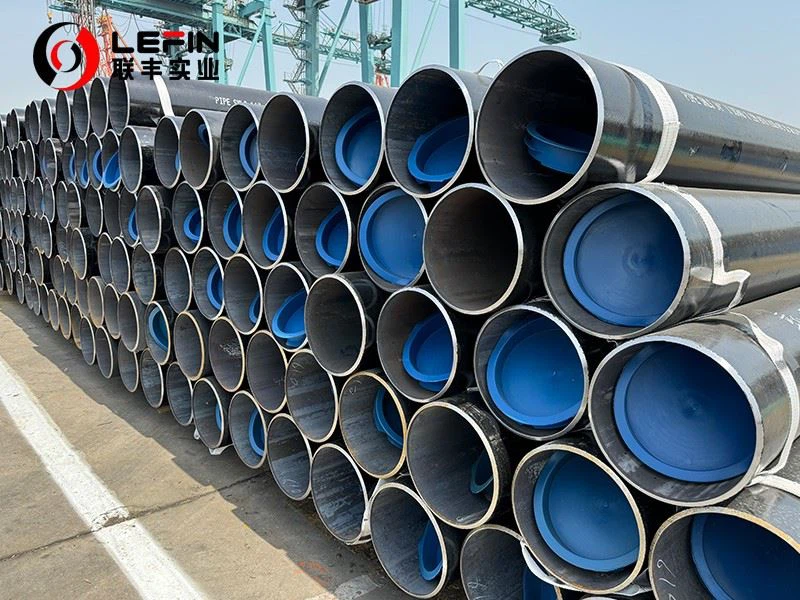


Tianjin Lefin Industrial Co., Ltd is one of the most experienced manufacturers and suppliers of plastic-coated steel pipe in China. Please feel free to buy high quality plastic-coated steel pipe from our factory. Good service and reasonable price are available.
Here is a comprehensive explanation of all the questions you asked: what it is, what it does, how to apply it, whether to apply it inside and outside, the thickness and standard, production precautions, and significance. Please keep it as simple and detailed as possible.
1. What is plastic-coated steel pipe?
Plastic-coated steel pipe = Ordinary steel pipe (carbon steel/welded pipe/seamless pipe) + A layer of plastic coating on the inner and outer walls (or inner wall), also known as steel-plastic composite pipe.
- Base material: Q235, Q345, etc. welded pipe/seamless pipe/spiral pipe
- Coating: EP (epoxy resin), PE (polyethylene), PVC, etc. powder, which is heated and fused onto the surface of the steel pipe
- Structure: Steel skeleton plastic garment - It has the strength of steel pipe and the advantages of plastic corrosion resistance, no scaling, and hygiene of plastic.
II. What is it used for?
In one sentence: It replaces ordinary galvanized steel pipes/black steel pipes, addressing issues such as "rusting, scaling, corrosion, and secondary pollution", and is used for the transportation of pressure fluids in areas like water supply and drainage, fire protection, chemical industry, mining, gas, seawater, and circulating water.
Typical scenarios:
- Municipal tap water, purified drinking water (safe and non-toxic)
- Fire sprinklers/ fire hydrants (red EP/PE, flame retardant)
- Chemical acid and alkali, salt spray environment (EP resistant to chemicals)
- Seawater, ports, coastal projects (salt spray protection)
- Mine tailings, wear-resistant pipelines (PE with good toughness)
III. How to apply? Should both the inside and outside be coated?
1) Should both the inside and outside be coated?
The majority cases involve coating both the inside and outside; a few cases only coat the inner wall (for water supply) or only the outer wall (for underground anti-corrosion).
- Water supply / Drinking water: Coated both inside and outside (inner wall food grade)
- Underground sewage / Chemicals: Coated both inside and outside
- Indoor fire protection: Coated both inside and outside
- Old pipe repair: Sometimes only the inner wall is coated
2) Main process (all are "powder melting and solidification", not simple painting)
① Electrostatic spraying (most commonly used, both EP/PE can be used)
- Preheat the steel pipe to 180–220℃
- The powder becomes charged, and the spray gun is used to spray onto the inside and outside of the steel pipe, achieving uniform electrostatic adsorption
- Put into the curing oven for 15–20 minutes, melting and leveling into a dense and hard layer
- Features: thin and uniform, strong adhesion, can be painted on both inside and outside
② Hot-dip coating (fluidized bed, mainly PE)
- Preheat the steel pipe to 240–270℃
- Immerse in the fluidized bed of PE powder, where the powder melts and coats the surface upon heating
- Secondary curing and cooling
- Features: Thick coating, strong corrosion resistance, commonly used for outer walls or large diameters
③ Vacuum coating (inner wall of small-diameter long tube)
- Vacuum is applied inside the tube, and powder is sucked in
- Rotating heating causes the powder to melt and adhere to the inner wall
Simple process:
Steel pipe → Cutting to remove burrs → Sandblasting for rust removal (Sa2.5 grade) → Preheating → Electrostatic spraying / Inorganic coating → Drying → Cooling → Inspection → Packaging

IV. What are the requirements for thickness and standards?
1) Coating thickness (GB/T 28897, CJ/T 120, etc.)
EP (epoxy resin, thin, dense, temperature-resistant)
- Inner wall: 0.3–0.45 mm (DN15–DN300)
- Outer wall: 0.3–0.8 mm
- Commonly used for water supply/fire protection: 0.3–0.4 mm
PE (Polyethylene, thick, toughness, wear-resistant)
- Inner wall: DN ≤ 65 ≥ 0.4 mm; DN 80–150 ≥ 0.5 mm; DN ≥ 600 ≥ 0.8 mm
- Outer wall: ordinary ≥ 0.6 mm; reinforced ≥ 0.8–1.2 mm
2) Inner pipe wall thickness
According to the national standard for ordinary steel pipes (GB/T 3091), for example:
- DN15–DN150: 2.0–4.5 mm
- DN200–DN600: 4.0–9.0 mm
3) Key Standards
- CJ/T 120-2016: Wrought Plated Composite Water Pipes (Mandatory)
- GB/T 28897-2021: Technical Specifications for Coating on the Inside and Outside of Steel Pipes
- GB/T 5135.20: Fireproof Wrought Plated Pipes
V. What should be noted during production? (Key points for determining quality)
1. Rust removal must be thorough (most crucial)
- Sandblasting/shot blasting to Sa2.5 grade (near-white level)
- Roughness Ra 40–70 μm; otherwise, the coating will likely peel off within 1–3 years
2. Precise temperature control
- Preheating: EP ≈ 220℃, PE ≈ 250℃
- Drying: EP 200–220℃/15–20 minutes; PE 180–200℃/10–15 min
- High temperature → Bubbles, pinholes; Low temperature → Poor adhesion, prone to powder shedding
3. The coating is uniform and free of pinholes.
- The difference in thickness between the inside and outside is ≤ ±10%.
- Electrospark test (2–5 kV) shows no breakdown (pinholes = corrosion channels)
4. Reinforcement of pipe openings and weld seams
- Repainting of welds and pipe openings, as these areas are most prone to inadequate coating and the earliest to corrode.
5. Clean and dry environment
- Humidity should be no more than 65%, otherwise the powder will absorb moisture and the static electricity will fail.

VI. What is the significance of plastic-coated steel pipes? (Why do we need to apply the coating?)
1. Completely solve corrosion problems and significantly extend service life
- Ordinary steel pipes: Rust through within 5-10 years
- Plastic-coated steel pipes: Last for 50 years or more (30 years or more in salt spray environment)
2. Hygiene and safety, eliminating secondary pollution
- The inner wall is smooth, does not rust, does not form scale, and does not release heavy metals. It can be directly used for direct drinking water.
3. Energy-saving and high water delivery efficiency
- The friction coefficient is only 1/5 of that of ordinary steel pipes, resulting in a reduction of approximately 18% in water delivery energy consumption, and saving electricity for the pumping station.
4. Lower overall cost
- Although it is 20-40% more expensive than galvanized pipes, it requires no maintenance, has a long lifespan, and requires fewer replacements, resulting in a lower total life cycle cost.
5. Strength and Corrosion Resistance Combined
- Has higher pressure resistance, better impact resistance, and can be buried compared to pure plastic pipes
- Has better corrosion resistance, better hygiene, and lower resistance compared to pure steel pipes

Summary in one sentence
Plastic-coated steel pipe = The strength of steel pipe + the anti-corrosion and hygiene properties of plastic.
It is coated on both the inside and outside (in most cases), using electrostatic spraying / hot-dip plasticating and high-temperature fusion welding.
The thickness is strictly in accordance with national standards based on the pipe diameter and material. The key to production lies in rust removal, temperature control, and no pinholes; its significance is longevity, hygiene, energy saving, and cost reduction.

Hot Tags: plastic-coated steel pipe, China, suppliers, manufacturers, factory, price, Square Steel Tubing, CHS Steel Tube S355JR, HOT FORMED STEEL PIPE, STKR400 STKR490 Structural Hollow Section, JIS G3466 Square And Rectangular Tubes, Saudi Arabia S355J2H SHS RHS Steel


