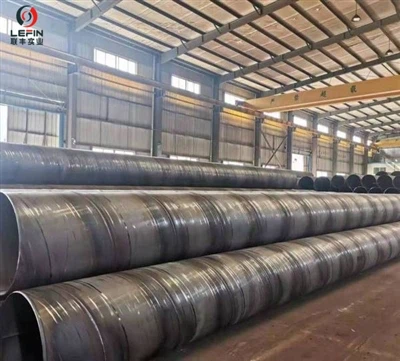
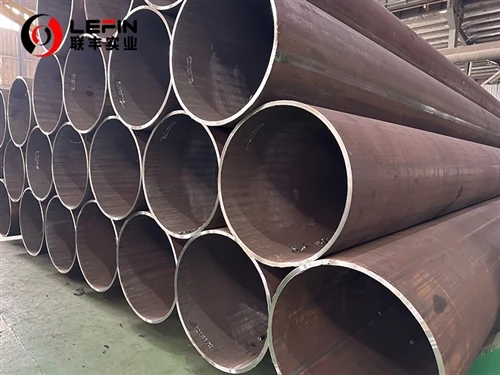
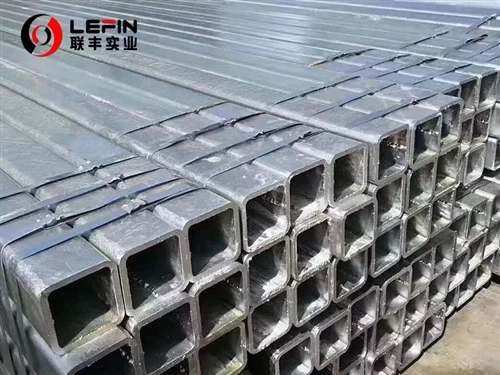
Straight seam welded pipes are steel pipes formed by bending steel plates or steel strips and then welding along the longitudinal axis. They are mainly divided into two production routes: ERW/HFW high-frequency resistance welding (for medium and small diameters) and LSAW straight seam submerged arc welding (for large diameters and thick walls). Here is a complete and detailed analysis of the entire production process.
I. Raw Material Preparation and Pre-treatment (Common to Both Processes)
1. Raw material acceptance and inspection
- Raw materials: Hot rolled coil (ERW), medium-thick steel plates (LSAW), materials such as Q235, Q355, X42 to X80 pipeline steel, etc.
- Inspection:
- - Verify the quality certificate (chemical composition, mechanical properties)
- - Full plate ultrasonic testing (plate inspection): Check internal layering, inclusions, and cracks in the steel plates.
- - Visual inspection: No rust, dents, scratches, or wave-like deformation.
2. Pre-treatment of steel plates/steel strips
- ERW process (steel strips):
- Uncoiling: Uncoiling of steel coils onto the machine
- Straightening: Multi-roller straightening machine to eliminate roll stress
- Edge cutting/milling: Shearing or milling of the sides to ensure consistent width and straight edges
- Edge-to-edge welding: Flash welding of the head and tail of the steel strip to achieve continuous production
- Live coil storage: Buffering for continuous production
- LSAW Process (Steel Plate):
1. Cutting to Fixed Length: Cut the steel plate according to the length of a single pipe.
2. Edge Milling: Mill both sides, processing standard bevels (such as V-shaped), controlling burrs and angles.
3. Pre-bending: Use a pre-bending machine to pre-bend the edges of the plate to ensure proper joint alignment and prevent "pear-shaped" deformation.
II. Forming Process (Core Difference)
1. ERW/HFW High Frequency Welding - Continuous Roll Forming
- Spindle arrangement / Multi-stand continuous forming:
- The steel strip undergoes 20 to 36 forming rolls, gradually transforming from sheet → open pipe blank → jointed circular pipe
- Forming section: Rough forming → Fine forming → Extrusion section
- Key controls: Edge alignment, edge deviation ≤ 0.15t, ellipticity
2. LSAW Submerged Arc Welding - JCOE/UOE Forming (Large Diameter)
- JCO Forming (Commonly Used):
1. J Forming: Half of the steel plate is stepped stamped into a J shape
2. C Forming: The other half is stamped into a C shape
3. O Forming: The entire piece is joined together to form an open-ended circular tube
4. Expansion (E): Full-length mechanical expansion to increase the size accuracy and eliminate internal stress
III. Welding Process (Core Difference)
1. ERW/HFW High-frequency Resistance Welding (without filler metal)
- Principle: Utilizing high-frequency current, skin effect + proximity effect
- Edge is rapidly heated to 1300-1500℃ to a molten state
- Compression roller applies pressure, forging and fusing to form a metallurgical bond between base materials
- Process:
1. High-frequency welding: Induction/contact type high-frequency welding machine
2. Deburring: Scrapers on the inside and outside of the weld seam remove weld spurs
3. Welding heat treatment (optional): Medium-frequency annealing to eliminate welding stress
2. LSAW Straight Seam Submerged Arc Welding (Double-sided Multi-layer)
1. Pre-welding (Fixing Welding): MAG gas shielded welding for continuous seam alignment
2. Inner Welding: Multi-wire submerged arc welding inside the pipe (1-4 wires), with automatic welding gun
3. Outer Welding: Multi-wire submerged arc welding outside the pipe (1-4 wires)
- Parameters: Current 500-1000A, Voltage 30-38V, Speed 0.5-1.2m/min
IV. Post-weld finishing and dimension correction
1. Cooling and Cutting
- Air-cooling / Water-cooling to room temperature
- Cutting to the specified length (by flying saw / sawing)
2. Dimensional Finishing
- ERW:
- Roundening/Constant Diameter Unit: Ensures outer diameter accuracy
- Straightening: 2-4 roll straightening machine
- LSAW:
- Mechanical Expansion (E Process): Full-length expansion, ellipticity ≤ ±0.5%D
- Pipe End Roundening, Flat Head Chamfering
3. Pipe end processing
- Chamfering/Beveling: Create welding bevels (30° - 37.5°) for ease of on-site welding
V. Full-process Quality Inspection (Critical Quality Control)
1. Ultrasonic Testing (UT)
- 100% inspection of plate inspection and weld seams: cracks, incomplete penetration, slag inclusion
2. X-ray/γ-ray Testing (RT)
- 100% industrial television/photography of weld seams, according to API/GB standards
3. Hydrostatic Test
- Sequential pressure testing: P = 2St/D (S = yield strength, t = wall thickness, D = outer diameter)
- Maintain pressure for 5 to 10 seconds, no leakage, no deformation
4. Non-Destructive Testing (NDT)
- Magnetic Particle/Phonon (MT/PT): surface cracks
5. Physical and Chemical Tests (Batch)
- Tensile, bending, impact, metallographic, hardness
VI. Surface Treatment and Finished Product Storage
1. Surface treatment
- Rust removal: Shot blasting / Sandblasting (Sa2.5 grade)
- Corrosion protection: Painting, Galvanizing, 3PE anti-corrosion layer (Oil and gas pipelines)
2. Identification and packaging
- Marking: Specifications, material, furnace number, standard, trademark
- Packaging, weighing, storage
VII. Key Quality Control Points
- Forming: Offset dimension, ellipticity, edge alignment
- Welding: Temperature, extrusion force, speed, weld height
- Heat Treatment: Annealing temperature, holding time (stress relief)
- Non-destructive Testing: 100% UT/RT, no leakage under water pressure
- Expansion: Expansion rate 0.5% - 1.5% (LSAW)