


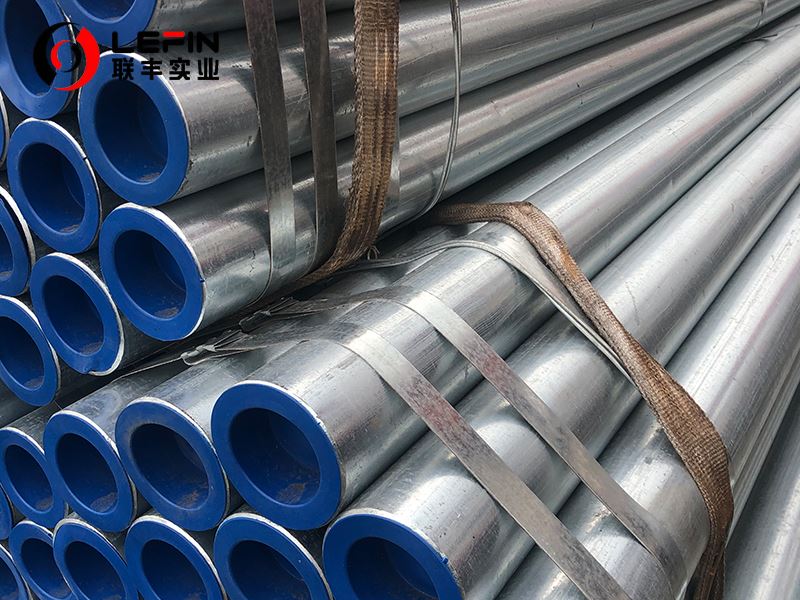


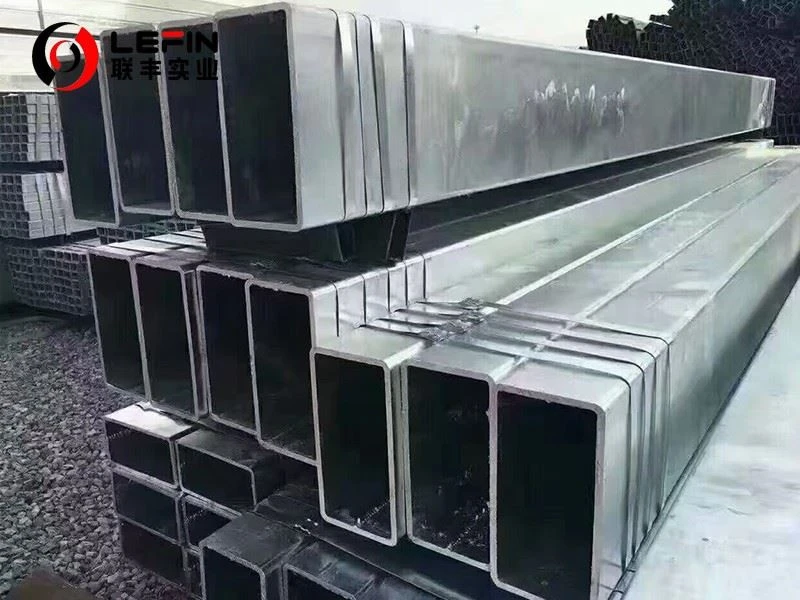


Tianjin Lefin Industrial Co., Ltd is one of the most experienced manufacturers and suppliers of classification and differences of galvanized pipes in China. Please feel free to buy high quality classification and differences of galvanized pipes from our factory. Good service and reasonable price are available.
I. Core Classification of Galvanized Pipes
According to the galvanizing process and production flow, the mainstream galvanized pipes on the market can be divided into three categories:
- Hot-dip Galvanized Pipes (Hot-Dip Galvanized, HDG): The finished pipes are hot-dip galvanized as a whole. They are the most common anti-corrosion pipes in the engineering field.
- Electro-galvanized Pipes (Cold-Dip Galvanized, EG): The zinc layer is deposited by electrolysis on the outer surface of the pipe. They are thin-galvanized products with light anti-corrosion properties.
- Pre-galvanized Pipes (Galvanized Strip Pipes/Steel Strip Galvanized Pipes, Pre-galvanized): They are welded from pre-galvanized steel strips. They are also commonly known as "cold strip galvanized pipes".
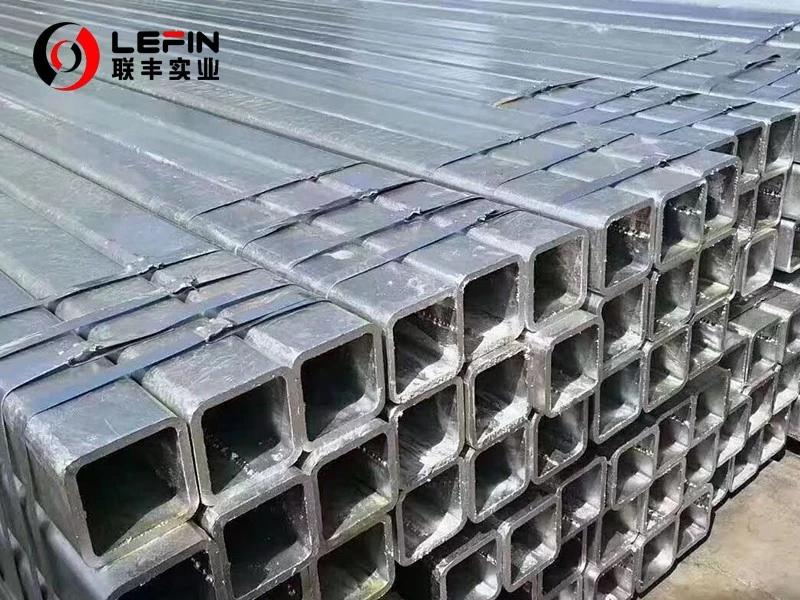
II. Electro-galvanizing (Cold-galvanizing) vs Hot-galvanizing: Core Differences and Characteristics
These two are completely different galvanizing processes, with significant differences ranging from principle to performance.
1. Essential Differences in Process
- Hot-galvanized Pipes: The already formed pipes (welded pipes/ seamless pipes) are acid-washed and treated with auxiliary plating before being immersed in molten zinc at 440-460°C. Through a metallurgical reaction, a zinc-iron alloy layer + pure zinc layer composite coating is formed on the surface of the pipe, which is a high-temperature metallurgical combination. The inner and outer walls, as well as weld seams, can be completely covered with zinc layers.
- Electro-galvanized Pipes (Cold-galvanized): At room temperature, zinc ions are deposited on the outer surface of the pipe through the electrolysis principle, forming only a single pure zinc layer. It is a low-temperature physical adhesion. The inner wall of the pipe can hardly be coated with zinc, and the weld seam is prone to incomplete coating.
2. Performance and Lifespan Differences
- Adhesion: Hot-galvanized is a metallurgical combination, and the zinc layer is integrated with the pipe base, making it less likely to peel off even under bending, impact, or collision; electro-galvanized is electrostatic adsorption, with weak adhesion, and slight scratches will cause the zinc layer to peel off.
- Anti-corrosion Capacity: Hot-galvanized has both physical barrier + sacrificial anode cathodic protection, and its anti-corrosion capacity is 5-10 times that of electro-galvanized.
①Indoor Dry Environment: Hot-galvanized has a lifespan of 30-50 years, while electro-galvanized lasts 8-15 years
②Outdoor Ordinary Environment: Hot-galvanized lasts 15-25 years, while electro-galvanized lasts 2-5 years
③Coastal/High Humidity/Buried: Hot-galvanized lasts 15-30 years, while electro-galvanized lasts 0.5-2 years. It is generally not recommended for use
- Salt Spray Test: Hot-galvanized can pass 240-1000 hours of neutral salt spray without rust; electro-galvanized usually shows rust after 48-100 hours.
3. Appearance and Processing Properties
- Hot-galvanized: The surface is matte silver-gray, with some zinc flakes and bumps, and the texture is rough; the zinc layer is prone to volatilization and generating zinc smoke during welding.
- Electro-galvanized: The surface is smooth and shiny, with a more beautiful appearance; welding is relatively easy, but the coating is prone to bubble formation at high temperatures.
4. Application Scenarios
- Hot-galvanized Pipes: Municipal water supply and drainage, fire protection pipes, outdoor scaffolding, buried wiring, photovoltaic supports, coastal projects, guardrail posts, etc., which require high anti-corrosion, are the mainstream choices in construction projects.
- Electro-galvanized Pipes: Only suitable for indoor dry environments, such as electrical wiring pipes, indoor decorative supports, furniture pipe materials, etc. In China, cold-galvanized pipes have been explicitly prohibited from being used as water supply pipes.
III. Pre-galvanized (Galvanized Strip Pipes) vs Hot-galvanized Pipes: Detailed Differences
1. Core Difference: It is the sequence of processes, not the material of the raw materials
The base materials of both are ordinary carbon steel. The essential difference is the sequence of the galvanizing process, not the material difference of the raw materials:
- Hot-dip galvanized pipe: First, the carbon steel strip is welded into a finished pipe, and then the entire pipe is immersed in the zinc bath to complete the galvanization (post-galvanization process).
- Pre-galvanized pipe (galvanized strip pipe): First, the carbon steel strip (sheet material) is continuously hot-dip galvanized at the steel mill to obtain galvanized strip steel, and then the galvanized strip steel is welded into a pipe (galvanization first, then pipe manufacturing).
In simple terms: One is "make the pipe first and then galvanize it", and the other is "galvanize the zinc well before making the pipe".
2. Performance and application differences in different environments
- Anti-corrosion life: The anti-corrosion life of hot-dip galvanized pipe is 35 times that of pre-galvanized pipe. Pre-galvanized pipes usually start to rust at the welds after 25 years in outdoor environments, while hot-dip galvanized can be used stably for more than 15 years.
- Appearance and specifications: Pre-galvanized pipes have a smoother and brighter surface, higher dimensional accuracy, and are mainly thin-walled small pipes; hot-dip galvanized pipes have a rougher surface, and larger diameter and thicker wall specifications are more complete.
- Cost and efficiency: Pre-galvanized pipes are produced continuously, with high efficiency and low cost, and the price is usually 30% to 50% lower than the same specification hot-dip galvanized pipes; hot-dip galvanized pipes are batch production, with large zinc consumption and higher cost.
- Applicable scenarios:
①Hot-dip galvanized pipe: Outdoor projects, low-pressure fluid transportation (water, gas), underground laying, scaffolding, load-bearing structures, etc., high-demand scenarios.
②Pre-galvanized pipe: Indoor light structures, vegetable greenhouse frameworks, guardrails, furniture pipes, electrical wiring, temporary construction, etc., dry, low-corrosion, low-load scenarios.

IV. Summary
- Pursuing long-term anti-corrosion, outdoor/mounted underground/for water transportation → Select hot-dip galvanized pipe
- Indoor dry, high decorative requirements, limited budget → Can choose pre-galvanized pipe (galvanized strip pipe)
- Only temporary use, extremely low anti-corrosion scenarios → Can consider electro-galvanized pipe, but not recommended for outdoor and water transportation scenarios
Hot Tags: classification and differences of galvanized pipes, China, suppliers, manufacturers, factory, price, ASTM A501 GR A SHS, Class A Circular Hollow Section, Hollow Steel Section, Hot Dip Aluzinc Steel Coil, Hot Finish Seamless Hollow Section, SQUARE TUBE


