


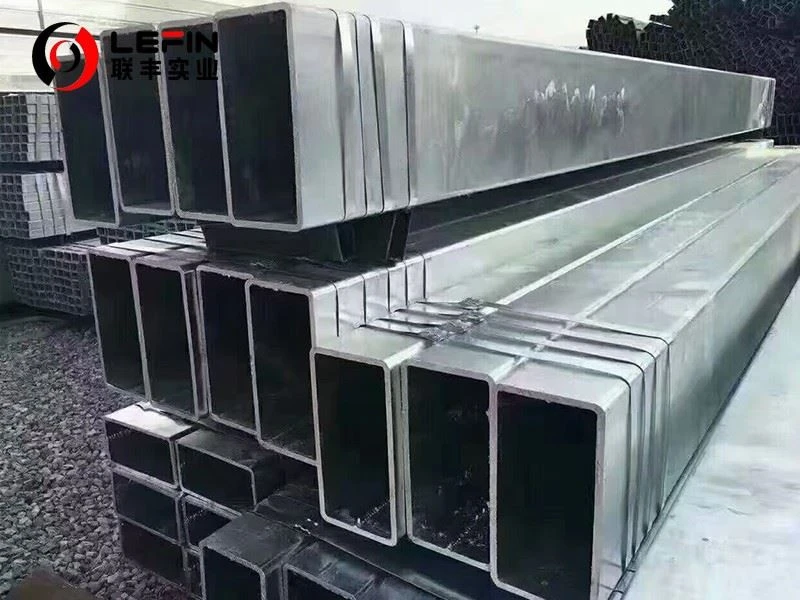

Tianjin Lefin Industrial Co., Ltd is one of the most experienced manufacturers and suppliers of storage and rust removal of square tube sections in China. Please feel free to buy high quality storage and rust removal of square tube sections from our factory. Good service and reasonable price are available.
The core objective of preserving square and rectangular steel pipes (square/rectangular steel tubes) is to prevent rusting, deformation, impact damage, and corrosion.
The storage plan should be implemented according to the storage period, site conditions, and pipe type, and the following are the complete operation specifications and precautions:
I. Selection of Storage Location (in order of priority)
1. Indoor closed warehouse (preferred for long-term storage)
- Suitable for thin-walled pipes, galvanized pipes, stainless steel pipes, and high-value precision square and rectangular steel tubes. The requirement is that the doors and windows are sealed and equipped with ventilation devices to maintain a dry environment without water accumulation.
- Open the ventilation and dehumidification devices on sunny days, close the doors and windows on rainy days to prevent moisture, and the relative humidity in the warehouse should be controlled below 60%.
- The ground should be hardened with cement to avoid moisture seepage.
2. Ventilated storage shed (intermediate temporary storage)
- Medium-sized and ordinary carbon steel square and rectangular steel tubes can be stored in a roofed shed. It is necessary to ensure that there is a covering on top and a raised base below, and the top cover should be complete without leakage.
- Keep the surrounding areas well ventilated to avoid water vapor accumulation on the surface of the pipes.
3. Outdoor temporary stacking (only for short-term storage)
- Only suitable for short-term turnover of large-diameter thick-walled carbon steel square and rectangular steel tubes. The location must be on a high ground with smooth drainage, without water accumulation dead spots, and avoid low-lying areas prone to flooding.
- Must build a fully covered shelter to prevent direct sun exposure and rain exposure without cover.
II. Standard stacking operation (to prevent deformation and collapse)
1. Raise the bottom (mandatory requirement)
In any scenario, it is strictly prohibited for square and rectangular steel tubes to directly contact the ground. The capillary moisture on the ground is the main cause of bottom rusting:
- Indoor cement floor: Raise 0.1m (wooden planks, plastic pads, square steel can be used)
- Indoor clay floor: Raise 0.2~0.5m
- Outdoor cement ground: Raise 0.3~0.5m
- Outdoor sandy soil ground: Raise 0.5~0.7m
- The pads should be flat and sturdy, evenly arranged along the length of the pipe, with a spacing of no more than 1.5m to ensure uniform force distribution without bending.
2. Control of stacking height and layers
Follow the principle of "light on top, heavy at the bottom, layer-by-layer placement, strictly control the height". To avoid deformation of the lower layer pipes due to pressure:
- Manual operation stacking height: no more than 1.2m
- Mechanical operation stacking height: no more than 1.5m
- Thin-walled square and rectangular steel tubes (wall thickness ≤ 3mm): stacking layers should not exceed 3 layers
- Large-diameter thick-walled pipes: it is recommended to stack in single or double layers
- The width of the stack should be controlled within 2.5m to prevent the center of gravity from shifting and causing collapse
3. Stack layout
- Reserve a 0.5m-wide inspection passage between stacks, and a 1.5~2m-wide main access passage for inspection and forklift operations.
- Concentrate the same specification and batch of pipes for stacking, align the wooden pads vertically on the same vertical line to avoid local stress causing section deformation (flat pipe, rhombic deformation).
- For long-diameter pipes (>6m), additional wooden supports must be added in the middle, with one every 2~3m, to prevent self-weight bending.

III. Core operations for rust and moisture prevention
- Balance ventilation and covering: When stored outdoors or in a storage shed, the covering material (rainproof cloth, waterproof tarpaulin) should be durable and leak-proof; the covering should not be completely sealed, and a ventilation gap should be reserved to avoid water vapor not being able to evaporate and accumulating on the surface, accelerating rusting.
- Details for pipe ends to prevent moisture: It is recommended to remove the plastic protective covers at the pipe ends after stacking to avoid water accumulation in the gaps between the protective cover and the pipe wall that is difficult to evaporate, causing local rusting at the pipe ends.
- Surface pre-treatment: · Bare carbon steel pipes before entering the warehouse can be uniformly sprayed with anti-rust oil or painted with anti-rust primer, significantly extending the storage period. · In coastal and rainy seasons with high humidity, waterproof tape can be wound around the outer layer, combined with desiccant use.
- Avoid contact with contaminants: The storage area must not stack acidic, alkaline, oil, or copper materials that have corrosive effects on steel to prevent the surface of the pipes from being contaminated and accelerating rusting.
IV. Requirements for classification and zoning storage
1. Material strict isolation
- Carbon steel pipes, galvanized pipes, and stainless steel pipes must be stored separately in different areas and must not be in direct contact. Contact between different metals will cause electrochemical corrosion, accelerating the aging of the pipes.
- Pipes with different surface treatments (black pipes, galvanized, painted, polished) should be stacked separately to avoid scratches and abrasions on the coatings.
2. Clear specification and batch
- Stack according to side length, wall thickness, length, and production batch. Hang a label on each stack, indicating the specification, material, quantity, and date of entry, to avoid mixing and incorrect dispatch.
3. First-in-first-out management
- Stack the same material pipes in order of entry. Follow the first-in-first-out principle to avoid long-term accumulation and over-storage of a single batch of pipes.
V. Daily maintenance and storage period
- Regular inspection:Inspect at least once a month, focusing on checking for moisture, rust spots, and water accumulation at the bottom, pipe ends, and under covers. Check if the wooden supports are loose or sinking.
- Timely rust removal and protection: Immediately clean minor rust spots with sandpaper or rust remover, reapply anti-rust oil or anti-rust paint to prevent the rust spots from expanding.
- Recommended storage period
- Ordinary carbon steel pipes: No more than 6 months
- Hot galvanized, coated anti-corrosion pipes: No more than 12 months
- Stainless steel pipes: Can be stored for 12-18 months in a dry environment
Over-storage will significantly increase the risk of rusting and deformation. Even if the environment is good, the frequency of inspections should be increased.
VI. Key prohibitions
- Prohibit storage in low-lying water areas or near water sources/steam pipes.
- Prohibit stacking beyond height and width limits. Do not place heavy objects on the pipe stack.
- Prohibit stacking pipes of different specifications and materials together. Do not stack large pipes on top of small ones.
- Prohibit storing pipes completely wrapped in non-aerated plastic film. This is prone to moisture accumulation and rusting.
- Prohibit throwing, dragging, or bumping during handling and stacking to avoid pipe openings being damaged, deformation of the anti-rust layer.
The following provides rust removal operations and subsequent protection steps for mild and moderate rust on carbon steel, hot galvanized, and stainless steel pipes, respectively.
These are practical on-site procedures that can be implemented; for severe rust (significant wall thickness reduction, perforation, large-area dents and deformation), it is not recommended to repair, but rather to downgrade or scrap the pipes.

I. Rust removal and protection operation for carbon steel (black pipe) square and rectangular tubes
The most common type of rust on carbon steel square and rectangular tubes is surface rust. It is classified into two levels for treatment. The core principle is: thorough rust removal → immediate sealing → avoiding secondary moisture absorption.
1. Light floating rust (only surface brownish rust, no depressions or loose debris when touched by hand)
Tools required: ordinary steel wire brush, 80-120 mesh sandpaper, dry dust-free cloth, brush Operation steps:
- First, use a wire brush to repeatedly dry brush along the axial direction of the pipe material to completely remove surface rust, dust, and loose soil. Focus on cleaning the dead corners such as the pipe ends and the contact positions with the wooden pads.
- Use sandpaper to polish the remaining rust-colored areas, until the metal base color is exposed evenly. There is no need for excessive polishing.
- Use a dry cloth to thoroughly wipe off the rust powder on the surface to ensure no particles remain.
- Within 1 hour after rust removal, complete the repair: Use a brush to evenly apply a layer of anti-rust oil (such as calcium-based anti-rust grease, solvent-based anti-rust oil), or spray a quick-drying anti-rust primer, to completely cover the polished area.
2. Moderate rust (with obvious reddish-brown rust spots, slight dents, hardened rust layer, not penetrating the wall thickness)
Tools required: Wire brush, angle grinder (with steel wire wheel), 60-80 mesh sandpaper, rust remover (phosphate-based neutral rust remover), water, dry cloth, anti-rust primer + topcoat Operation steps:
- First, use a wire brush or angle grinder to polish off the thick rust layer, remove the raised rust nodules and loose rust layers. Be sure to control the force to avoid excessive grinding that may cause the wall thickness to decrease.
- For the remaining rust stains inside the pits, apply rust remover, let it stand for 5 to 10 minutes until the rust layer dissolves and loosens, then use sandpaper to polish it clean.
- Wipe off the remaining rust remover with clean water, allow it to completely dry (it is recommended to let it air dry for 24 hours naturally or use a hair dryer to dry it). Ensure there is no moisture on the surface.
- First, apply one layer of anti-rust primer (epoxy zinc-rich primer or red lead anti-rust paint are both acceptable), let it dry completely before applying another layer of paint to seal it. The coating range should extend 2 to 3 cm beyond the rusted area.
Notes for Attention
- Rust removal must be carried out on sunny days with dry air. Operations are prohibited on rainy, foggy or highly humid days.
- After treatment, the pipe materials should not be exposed to water or dust within 48 hours. They should be stacked after the protective layer is fully cured.
- If the rusted area exceeds 30% of the surface area of a single pipe, it is recommended to uniformly apply rust prevention treatment to the entire pipe to avoid significant color differences and uneven protection after local repair.
II. Rust Removal and Repair Operation for Hot-Dip Galvanized Square and Rectangular Tubes
The rust on galvanized tubes is mostly local rust caused by scratches or impacts on the coating. The core principle is to retain as much intact zinc layer as possible and only repair the damaged areas, using zinc replenishment instead of ordinary paint repair.
Applicable scenarios: Local damage to the coating, point-like/patch-like rust spots, with intact zinc layer around
Tool preparation: Nylon brush/steel wire brush (do not use ordinary carbon steel brush), 400-600 mesh fine sandpaper, dry cloth, cold galvanized spray agent (with zinc content ≥ 96%)/zinc-rich primer
Operation steps:
- Gently remove the rust and debris from the damaged area using a nylon brush, only sand the areas with rust, and strictly prohibit large-scale sanding of the intact galvanized layer around it to avoid further zinc layer peeling.
- Gently sand the edges of the rusted area with fine sandpaper to achieve a smooth transition between the damaged area and the intact zinc layer, and remove burrs.
- Wipe the surface dust clean with a dry cloth to ensure it is dry and free of oil stains.
- Mix the cold galvanized spray agent, spray it evenly at a distance of 20-30 cm from the pipe, apply 2-3 thin layers, with an interval of 5-10 minutes between each layer, and the spraying range should extend 1-2 cm beyond the damaged edge.
- If there is no cold galvanized spray agent, you can apply epoxy zinc-rich primer instead, with a zinc content of ≥80% to ensure the cathodic protection effect.
Notes for Attention
- It is strictly prohibited to use ordinary carbon steel wire brushes to vigorously sand. This will scratch the large area of intact zinc coating, thereby accelerating the corrosion around it.
- When the large area of zinc coating on the galvanized pipe has fallen off, turned white, and is severely rusted, the zinc supplementation effect will be limited. It is recommended to downgrade it for use in non-corrosion protection scenarios.
- After zinc supplementation, avoid being exposed to rain or getting wet immediately. It should be left to stand at room temperature for 24 hours until the coating is fully cured.

III. Rust Removal and Protection for Stainless Steel Square and Rectangular Tubes
The rust on stainless steel square and rectangular tubes is mostly surface rust or point rust caused by carbon steel particles contamination. The core principle is: Do not use carbon steel tools to avoid secondary carbon steel contamination and rust. After rust removal, perform passivation and sealing.
1. Mild surface rust (yellowish-brown spots on the surface, smooth to the touch without pits, mostly caused by dust/carbon steel contamination)
Tool preparation: Stainless steel-specific wire brush, microfiber cloth, neutral cleaner, water, dry cloth
Operation steps:
- Dip a microfiber cloth in neutral cleaner and wipe along the texture of the pipe to remove surface stains and rust spots.
- Rinse thoroughly with clean water and immediately dry with a dry cloth to prevent water marks from forming rust spots.
- If there is still a slight color difference, use stainless steel cleaning paste or passivation paste to polish and restore the surface shine.
2. Spot rust / Local rust spots (with obvious point-like rust pits, mostly caused by carbon steel contact and chloride ion contamination)
Tools required: Stainless steel brush, stainless steel rust remover / passivation paste, 600 mesh or higher fine sandpaper, clean water, dry cloth, stainless steel passivation agent
Operation steps:
- Gently scrub the rust spots with a stainless steel wire brush to remove the surface rust layer. Do not use ordinary carbon steel wire brushes as they may embed carbon steel particles into the stainless steel surface, causing more severe rusting.
- Apply the stainless steel rust remover evenly and let it stand for 3 to 5 minutes (adjust the time according to the depth of the rust spots. Do not exceed the time to avoid corroding the base material).
- Thoroughly rinse off the rust remover with clean water, dry it, and check if the rust spots have been removed. If not, repeat the process once.
- After rust removal is complete, apply a layer of stainless steel passivator or use passivator paste for passivation treatment to form a protective film and enhance the anti-rust ability.
Notes for Attentio n
- The storage of stainless steel pipes must be completely isolated from carbon steel pipes. It is prohibited to have direct contact with carbon steel forklifts or steel wire ropes to avoid iron ion contamination.
- For stainless steel pipes used in coastal or high-salt spray environments, it is recommended to perform surface cleaning and passivation maintenance every 3 months to extend the anti-rust period.
IV. General Operating and Storage Closure Requirements
- Personal Protection: During rust removal operations, wear gloves, goggles, and a mask to prevent irritation to the skin and respiratory tract from rust powder and rust removers.
- Environmental Requirements: All rust removal and repair operations must be conducted in a dry and ventilated environment. Avoid exposure to rain and condensation within 24 hours after the operation.
- Stacking Requirements: After the processing of pipe materials is completed, when stacking, replace with dry pallets to prevent re-rusting from the bottom; and mark them properly, prioritizing their release for storage.
- Record Keeping and Tracking: For each batch of rust removal and repair work, make detailed records, including the processing date, degree of rust, and method. Focus on tracking during subsequent inspections.

Hot Tags: storage and rust removal of square tube sections, China, suppliers, manufacturers, factory, price, API 5L SSAW PIPE, ASTM A500 SquareTubing, EN 10219 Cold Formed Hollow Section, EN10210 S355J2H HOLLOW SECTION, EN10210 S355JR SHS STEEL TUBE, Sharp Angle Square And Rectangular Tube


