Introduction
Steel pipes are the backbone of modern infrastructure, serving critical roles in energy transmission, construction, and industrial applications. For procurement managers and engineers, understanding the fundamental manufacturing processes behind steel pipes is not just technical knowledge-it's a crucial factor in selecting the right product for your project's specific requirements, ensuring safety, efficiency, and cost-effectiveness. This guide provides a detailed overview of the four primary methods for manufacturing round steel pipes: Seamless (SMLS), Electric Resistance Welding (ERW), Longitudinal Submerged Arc Welding (LSAW), and Spiral Submerged Arc Welding (SSAW).
- Explore how High-Frequency Electric Resistance Welding creates strong, reliable pipes with exceptional production efficiency. Our dedicated article breaks down the technology behind this economical and versatile manufacturing method.
- Delve into the JCOE forming and Submerged Arc Welding processes that defineLSAW pipe. Learn why it's the trusted choice for critical oil and gas transmission lines in our detailed technical review.
- Discover the engineering behind the helical seam. Our focused article explains how the spiral forming process allows for remarkable diameter versatility and cost-effectiveness in large-diameter pipe production.
- For the most demanding high-pressure and high-temperature applications, seamless is paramount. Our in-depth guide covers the piercing and elongation processes that give SMLS pipe its unmatched integrity.
ERW Pipe: Efficiency and Economy
Electric Resistance Welding (ERW) pipe is formed by rolling a steel coil (skelp) into a cylindrical shape and welding the longitudinal seam.
Manufacturing Process
- Forming: A strip of steel (skelp) is passed through a series of forming rolls that gradually bend it into a cylindrical shape.
- Welding: The two edges of the strip are brought together. High-frequency electric current (either contact or induction method) is passed through the edges. The resistance to the current heats the edges to a forging temperature.
- Forging: The heated edges are pressed together by forge rolls, creating a solid-state weld without the use of filler metal.
- Weld Flash Removal: The excess material (weld flash) on the inner and outer surfaces is trimmed off.
- Sizing & Heat Treatment: The pipe is sized to its final diameter and often heat-treated to normalize the weld zone, making it indistinguishable from the parent metal.
Key Characteristics
- Cost-Effective: High production speed makes it economical for large-volume orders.
- Good Dimensional Accuracy: Excellent for structural applications.
- Applications: Water pipelines, fencing, scaffolding, structural applications (construction), and low/medium-pressure fluid transportation.

LSAW Pipe: Strength for Large Diameters
Longitudinal Submerged Arc Welded (LSAW) pipe is designed for large-diameter applications. It is made from steel plates (not coils).
Manufacturing Process (JCOE Method is common):
- Plate Preparation: Steel plates are cut to the required size.
- Edge Milling: The edges of the plate are milled to ensure a perfect fit for welding.
- Forming (J-C-O): The plate is pressed in a series of steps:
J-Forming: The long edges are pre-bent into a 'J' shape.
C-Forming: The plate is further pressed into a 'C' shape.
O-Forming: The 'C' shape is closed into an 'O' (circle) shape.
- Welding: The longitudinal seam is welded on the inside and outside using the Submerged Arc Welding (SAW) process. SAW uses a granular flux that covers the arc, preventing sparks and spatter and resulting in a deep, high-quality weld.
- Expansion: The pipe undergoes mechanical expansion (like in UOE process) or hydraulic expansion to achieve perfect roundness and relieve internal stresses.
- Testing & Inspection: Comprehensive non-destructive testing (NDT) like ultrasonic or X-ray is performed on the weld.
Key Characteristics
- Large Diameters: Capable of producing pipes with very large diameters (typically from 16 inches upwards).
- High Strength: The SAW process creates robust, reliable welds.
- Applications: Long-distance oil and gas transmission pipelines, piling, and offshore structures.

SSAW Pipe: Flexibility in Diameter
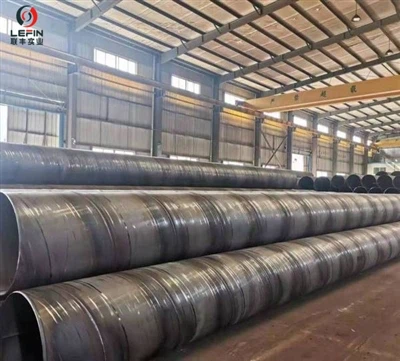
Spiral Submerged Arc Welded (SSAW or HSAW) pipe is also made from steel coils but is formed into a spiral shape.
Manufacturing Process:
- Coil Preparation: The steel coil is unrolled and leveled.
- Spiral Forming: The strip is fed at an angle through forming rolls, which wind it into a continuous spiral shape, much like a helix.
- Welding: The internal and external spiral seams are welded simultaneously using the Submerged Arc Welding (SAW) process, ensuring a strong, continuous weld.
- Cutting: The continuously produced spiral pipe is cut to the required lengths.
- Testing: The weld is inspected using various NDT methods.
Key Characteristics
- Diameter Flexibility: A key advantage is the ability to produce a wide range of diameters from the same width of steel strip by simply adjusting the forming angle.
- Longer Lengths: Can be produced in longer single lengths compared to LSAW.
- Applications: Water transmission, piling, and structural applications. Often used where high diameter-to-wall thickness ratios are needed.

SMLS Pipe: The Pinnacle of Uniformity
Seamless Steel Pipe (SMLS) is defined by its absence of a weld seam. It is manufactured from a solid cylindrical steel billet.
Manufacturing Process:
- Heating: A solid steel billet is heated to a high temperature until it becomes malleable (typically around 1,200°C / 2,200°F).
- Piercing: The red-hot billet is then pierced through the center by a mandrel to create a hollow shell. This is often done using a rotary piercing mill.
- Elongation: The hollow shell is subsequently rolled and stretched over a series of mandrels and plugs to achieve the desired diameter, wall thickness, and length.
- Sizing & Finishing: The pipe is finally sized to precise dimensions through a stretch reducing mill or a sizing mill. It is then straightened, cut to length, and subjected to rigorous inspection and testing.
Key Characteristics
- Strength: Superior pressure-bearing capacity due to homogeneous structure without a weak weld line.
- Uniformity: Consistent wall thickness around the circumference.
- Applications: Ideal for high-pressure, critical applications such as oil and gas pipelines, refinery equipment, power plants, and high-pressure hydraulic systems.

Comparison and Summary
| Feature | ERW (Electric Resistance Welded) | LSAW (Longitudinal Submerged Arc Welded) | SSAW (Spiral Submerged Arc Welded) | SMLS (Seamless) |
|---|---|---|---|---|
| Seam | Longitudinal straight seam | Longitudinal straight seam | Spiral (helical) seam | None |
| Starting Material | Steel coil (skelp) | Steel plate | Steel coil | Solid steel billet |
| Typical Size Range | Small to large diameters | Large to extra-large diameters | Medium to large diameters | Small to medium diameters |
| Relative Cost | Lower (most economical) | Higher | Competitive for large sizes | Higher |
| Key Strength | Cost-effective, good for structural | High strength in large diameters | Diameter flexibility, longer lengths | Uniform strength, high pressure resistance |
| Common Applications | Water, fencing, scaffolding, construction | Main oil & gas transmission pipelines, piling | Water transmission, piling, structural supports | Oil & gas extraction, high-pressure systems |
Conclusion
Choosing the right type of steel pipe is a strategic decision that impacts the integrity, longevity, and budget of your project. There is no single "best" process; each method offers distinct advantages tailored to specific operational demands.
At LEFIN STEEL, we master all these advanced manufacturing techniques. Our expertise ensures that we can guide you to the optimal pipe solution-whether your priority is maximum pressure resistance, cost-efficiency, or large-diameter capability.
Stay tuned for our upcoming deep-dive articles, where we will explore each manufacturing process in even greater detail.