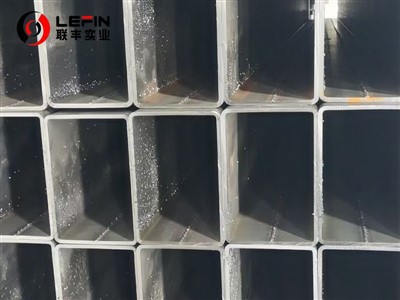
Tianjin Lefin Industrial Co., Ltd is one of the most experienced manufacturers and suppliers of astm a123 hot dip galvanzied steel pipe in China. Please feel free to buy high quality astm a123 hot dip galvanzied steel pipe from our factory. Good service and reasonable price are available.
ASTM A123 is a standard for hot-dip galvanizing (zinc coating) of steel products, which is widely used in various structural steels and steel pipes to enhance corrosion resistance. The following is a detailed introduction to ASTM A123 hot-dip galvanized steel pipes:
Standard Overview
Standard Name: ASTM A123/A123M - Standard Specification for Hot-Dip Galvanizing (Zinc Coating) of Steel Products.
Scope of application: It is applicable to steel products galvanized by hot-dip method, including structural components, steel pipes, plates, sections, etc., with a thickness of ≥ 1.6mm (It should be noted that steel pipes may need to be combined with other standards, such as ASTM A53).
Objective: To provide long-lasting anti-corrosion protection through zinc coating, suitable for scenarios exposed to corrosive environments.
Material Requirements
Base material: Usually carbon steel (such as ASTM A36, A53, etc.), which needs to be clean and free of impurities such as oxide scale and grease.
Pretreatment: Acid washing (hydrochloric acid or sulfuric acid) to remove rust, followed by treatment with a flux (such as ammonium zinc chloride) to enhance the adhesion of the zinc coating.
Galvanizing process
Zinc immersion: After pretreatment, the steel pipe is immersed in molten zinc liquid (about 449-454°C), where iron reacts with zinc to form an alloy layer.
Cooling: Air or water cooling to form an outer pure zinc layer, providing sacrificial anode protection.
Coating requirements
Thickness: Classified according to the thickness of the base material:
Material thickness < 1.6mm: Not applicable to A123.
1.6mm ≤ thickness < 3.2mm: The average coating thickness is ≥55 µm, and the local area is ≥43 µm.
Thickness ≥ 3.2mm: average ≥85 µm, local ≥70 µm.
Coating weight: It can be tested by weighing method (such as the mass of zinc coating per unit area, g/m²).
Quality control and testing
Visual inspection: The surface is continuous and uniform, without defects such as missed plating, bubbles, and zinc lumps.
Adhesion test: Hammering or cross-cutting test to ensure that the coating does not peel off.
Thickness measurement: Magnetic method or metallographic microscope method.
Corrosion resistance: Evaluated by salt spray tests (such as ASTM B117), but A123 does not specify the specific duration.

Application field
Architecture: Structural frames, guardrails, roof supports.
Infrastructure: Bridge components, street lamp poles, transmission towers.
Piping system: Water and gas delivery pipes, fire protection pipes (required to comply with pipe standards such as ASTM A53).
Industry: Storage shelves, agricultural equipment.
Comparison with other standards
ASTM A153: Suitable for small parts (bolts, nuts), with thinner coatings.
ISO 1461: International Equivalent standard. The requirements are similar, but there are slight differences in thickness classification.
ASTM A53: Steel pipe manufacturing standard. Galvanized steel pipes need to meet both A53 and A123 simultaneously.
Advantages and Limitations
Advantages:
Long-lasting anti-corrosion (20-50 years, depending on the environment).
It requires no maintenance and has good economy.
The coating is wear-resistant and can withstand wear during transportation and installation.
Limitation:
It may fail in high-temperature environments (> 200°C).
High-chlorine environments such as the ocean require additional protection (such as coating + galvanizing).
Precautions
Storage and handling: Avoid mechanical damage to the coating. In a humid environment, ensure good ventilation to prevent condensation.
Welding and cutting: The coating (such as cold galvanized paint) needs to be repaired to prevent local corrosion.
Version update: Confirm the latest version (such as ASTM A123-17), and pay attention to the revision of coating thickness or test methods.
Certification and Compliance
The manufacturer shall provide a third-party test report to prove compliance with ASTM A123.
Specific industries (such as drinking water pipelines) need to comply with additional standards such as NSF/ANSI 61.

Summary
ASTM A123 hot-dip galvanized steel pipes provide excellent anti-corrosion protection through molten zinc coating and are widely used in harsh environments. The strict standards for its coating thickness, adhesion and appearance ensure the product quality. Combined with other steel pipe standards (such as ASTM A53), it can meet diverse engineering requirements. Correct selection, installation and maintenance can maximize its service life.
Hot Tags: astm a123 hot dip galvanzied steel pipe, China, suppliers, manufacturers, factory, price, BRAZIL CIRCULAR PIPE, AS NZS 1163 C450 HOLLOW STRUCTURAL SECTION, EN 10210 HOLLOW STRUCTURAL SECTION, Hollow Structural Suqare Rectangular Section ASTM A 500, ASTM A500 HOLLOW SECTIONS, EN10219 STEEL HOLLOW SECTION